
Advertisement
- India
- /
- Capital Markets
- /
- NSEI:NBIFIN
N.B.I. Industrial Finance Company Limited's (NSE:NBIFIN) 32% Share Price Plunge Could Signal Some Risk

The N.B.I. Industrial Finance Company Limited (NSE:NBIFIN) share price has softened a substantial 32% over the previous 30 days, handing back much of the gains the stock has made lately. Looking back over the past twelve months the stock has been a solid performer regardless, with a gain of 20%.
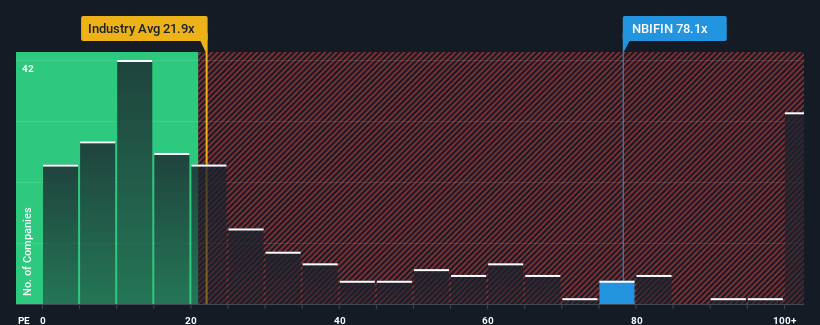
Even after such a large drop in price, given close to half the companies in India have price-to-earnings ratios (or "P/E's") below 30x, you may still consider N.B.I. Industrial Finance as a stock to avoid entirely with its 78.1x P/E ratio. Although, it's not wise to just take the P/E at face value as there may be an explanation why it's so lofty.
N.B.I. Industrial Finance has been doing a good job lately as it's been growing earnings at a solid pace. One possibility is that the P/E is high because investors think this respectable earnings growth will be enough to outperform the broader market in the near future. You'd really hope so, otherwise you're paying a pretty hefty price for no particular reason.
View our latest analysis for N.B.I. Industrial Finance
What Are Growth Metrics Telling Us About The High P/E?
The only time you'd be truly comfortable seeing a P/E as steep as N.B.I. Industrial Finance's is when the company's growth is on track to outshine the market decidedly.
If we review the last year of earnings growth, the company posted a worthy increase of 7.7%. The latest three year period has also seen an excellent 50% overall rise in EPS, aided somewhat by its short-term performance. So we can start by confirming that the company has done a great job of growing earnings over that time.
This is in contrast to the rest of the market, which is expected to grow by 26% over the next year, materially higher than the company's recent medium-term annualised growth rates.
In light of this, it's alarming that N.B.I. Industrial Finance's P/E sits above the majority of other companies. Apparently many investors in the company are way more bullish than recent times would indicate and aren't willing to let go of their stock at any price. There's a good chance existing shareholders are setting themselves up for future disappointment if the P/E falls to levels more in line with recent growth rates.
The Final Word
A significant share price dive has done very little to deflate N.B.I. Industrial Finance's very lofty P/E. Using the price-to-earnings ratio alone to determine if you should sell your stock isn't sensible, however it can be a practical guide to the company's future prospects.
Our examination of N.B.I. Industrial Finance revealed its three-year earnings trends aren't impacting its high P/E anywhere near as much as we would have predicted, given they look worse than current market expectations. When we see weak earnings with slower than market growth, we suspect the share price is at risk of declining, sending the high P/E lower. Unless the recent medium-term conditions improve markedly, it's very challenging to accept these prices as being reasonable.
You need to take note of risks, for example - N.B.I. Industrial Finance has 3 warning signs (and 1 which is concerning) we think you should know about.
If P/E ratios interest you, you may wish to see this free collection of other companies with strong earnings growth and low P/E ratios.
Valuation is complex, but we're here to simplify it.
Discover if N.B.I. Industrial Finance might be undervalued or overvalued with our detailed analysis, featuring fair value estimates, potential risks, dividends, insider trades, and its financial condition.
Access Free AnalysisHave feedback on this article? Concerned about the content? Get in touch with us directly. Alternatively, email editorial-team (at) simplywallst.com.
This article by Simply Wall St is general in nature. We provide commentary based on historical data and analyst forecasts only using an unbiased methodology and our articles are not intended to be financial advice. It does not constitute a recommendation to buy or sell any stock, and does not take account of your objectives, or your financial situation. We aim to bring you long-term focused analysis driven by fundamental data. Note that our analysis may not factor in the latest price-sensitive company announcements or qualitative material. Simply Wall St has no position in any stocks mentioned.
About NSEI:NBIFIN
N.B.I. Industrial Finance
A non-banking financial company, engages in the investing in shares and securities, and financial activities in India.
Excellent balance sheet with acceptable track record.
Market Insights

Advertisement
Community Narratives
WhiteCap Is Positioned To Profit Regardless Of Trump's Policy 
Fair Value CA$22.60|61.6% undervalued
ST
Equity Analyst and Writer
Microsoft's Evolution Will Drive Revenue to New Heights Fueled by AI
Fair Value US$360.00|28.3% overvalued
BR
Community Contributor
A CASE FOR USD$2.50 (CAD$3.44) BY 2028 (A 5-10 BAGGER)
Fair Value CA$3.44|87.8% undervalued
AG
Community Contributor