
Advertisement
- United States
- /
- Biotech
- /
- NYSE:ABBV
Tread With Caution Around AbbVie Inc.'s (NYSE:ABBV) 5.5% Dividend Yield
Could AbbVie Inc. (NYSE:ABBV) be an attractive dividend share to own for the long haul? Investors are often drawn to strong companies with the idea of reinvesting the dividends. If you are hoping to live on your dividends, it's important to be more stringent with your investments than the average punter. Regular readers know we like to apply the same approach to each dividend stock, and we hope you'll find our analysis useful.
In this case, AbbVie likely looks attractive to dividend investors, given its 5.5% dividend yield and seven-year payment history. We'd agree the yield does look enticing. The company also bought back stock during the year, equivalent to approximately 2.1% of the company's market capitalisation at the time. When buying stocks for their dividends, you should always run through the checks below, to see if the dividend looks sustainable.
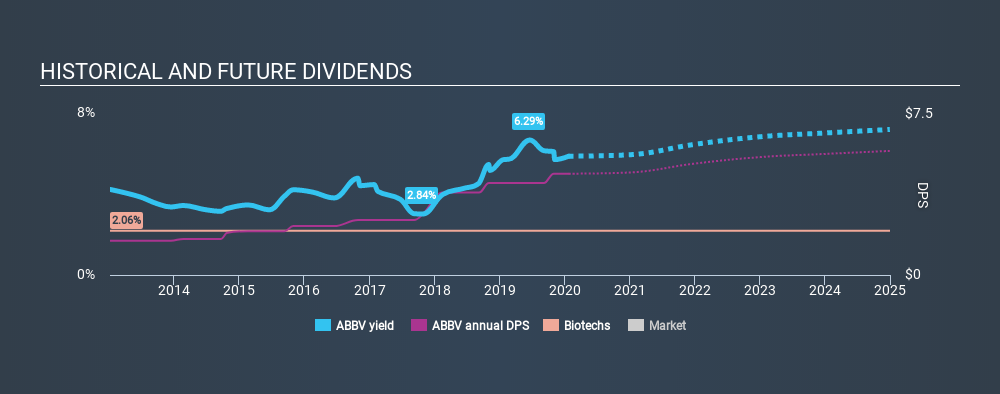
Explore this interactive chart for our latest analysis on AbbVie!
Payout ratios
Dividends are usually paid out of company earnings. If a company is paying more than it earns, then the dividend might become unsustainable - hardly an ideal situation. As a result, we should always investigate whether a company can afford its dividend, measured as a percentage of a company's net income after tax. AbbVie paid out 197% of its profit as dividends, over the trailing twelve month period. Unless there are extenuating circumstances, from the perspective of an investor who hopes to own the company for many years, a payout ratio of above 100% is definitely a concern.
In addition to comparing dividends against profits, we should inspect whether the company generated enough cash to pay its dividend. AbbVie paid out a conservative 48% of its free cash flow as dividends last year. It's good to see that while AbbVie's dividends were not covered by profits, at least they are affordable from a cash perspective. If executives were to continue paying more in dividends than the company reported in profits, we'd view this as a warning sign. Very few companies are able to sustainably pay dividends larger than their reported earnings.
Is AbbVie's Balance Sheet Risky?
As AbbVie's dividend was not well covered by earnings, we need to check its balance sheet for signs of financial distress. A rough way to check this is with these two simple ratios: a) net debt divided by EBITDA (earnings before interest, tax, depreciation and amortisation), and b) net interest cover. Net debt to EBITDA is a measure of a company's total debt. Net interest cover measures the ability to meet interest payments. Essentially we check that a) the company does not have too much debt, and b) that it can afford to pay the interest. AbbVie has net debt of 1.80 times its EBITDA, which is generally an okay level of debt for most companies.
We calculated its interest cover by measuring its earnings before interest and tax (EBIT), and dividing this by the company's net interest expense. Net interest cover of 10.95 times its interest expense appears reasonable for AbbVie, although we're conscious that even high interest cover doesn't make a company bulletproof.
Remember, you can always get a snapshot of AbbVie's latest financial position, by checking our visualisation of its financial health.
Dividend Volatility
Before buying a stock for its income, we want to see if the dividends have been stable in the past, and if the company has a track record of maintaining its dividend. Looking at the data, we can see that AbbVie has been paying a dividend for the past seven years. The dividend has been quite stable over the past seven years, which is great to see - although we usually like to see the dividend maintained for a decade before giving it full marks, though. During the past seven-year period, the first annual payment was US$1.60 in 2013, compared to US$4.72 last year. This works out to be a compound annual growth rate (CAGR) of approximately 17% a year over that time.
The dividend has been growing pretty quickly, which could be enough to get us interested even though the dividend history is relatively short. Further research may be warranted.
Dividend Growth Potential
Dividend payments have been consistent over the past few years, but we should always check if earnings per share (EPS) are growing, as this will help maintain the purchasing power of the dividend. It's not great to see that AbbVie's have fallen at approximately 3.3% over the past five years. If earnings continue to decline, the dividend may come under pressure. Every investor should make an assessment of whether the company is taking steps to stabilise the situation.
Conclusion
Dividend investors should always want to know if a) a company's dividends are affordable, b) if there is a track record of consistent payments, and c) if the dividend is capable of growing. We're not keen on the fact that AbbVie paid out such a high percentage of its income, although its cashflow is in better shape. Second, earnings per share have been in decline, and the dividend history is shorter than we'd like. In summary, AbbVie has a number of shortcomings that we'd find it hard to get past. Things could change, but we think there are likely more attractive alternatives out there.
Given that earnings are not growing, the dividend does not look nearly so attractive. See if the 8 analysts are forecasting a turnaround in our free collection of analyst estimates here.
Looking for more high-yielding dividend ideas? Try our curated list of dividend stocks with a yield above 3%.
If you spot an error that warrants correction, please contact the editor at editorial-team@simplywallst.com. This article by Simply Wall St is general in nature. It does not constitute a recommendation to buy or sell any stock, and does not take account of your objectives, or your financial situation. Simply Wall St has no position in the stocks mentioned.
We aim to bring you long-term focused research analysis driven by fundamental data. Note that our analysis may not factor in the latest price-sensitive company announcements or qualitative material. Thank you for reading.
M

The Foxhole
Berkshire sold Visa and Mastercard. Ackman just bought both. So whose "smart money" are you actually following?
137
m
marcus_l38oa
American Express is the bigger bet of Buffet than Mastercard and Visa. They are still holding it.
z
zoe_vi5fn
lol. what we should be discussing is Berkshire's cash pile. Close to 400 billion now.
 Andrew Legget
Market Insights
Great earnings season, but are the earnings real?

At first glance, this was the strongest earnings season in years. But when you look at where the growth actually came from, the story splits into two very different pictures.
85
About NYSE:ABBV
AbbVie
A research-based biopharmaceutical company, engages in the research and development, manufacturing, commercializing, and sale of medicines and therapies worldwide.
Reasonable growth potential average dividend payer.
Similar Companies
Market Insights


Advertisement
Weekly Picks
LO


Lou_Basenese on Oncolytics Biotech ·
The Team Behind a $2 Billion Johnson & Johnson (JNJ) Deal Just Took Over This $105 Million Cancer Biotech
Fair Value:US$3.576.0% undervalued
44 followersusers have followed this narrative
0 commentsusers have commented on this narrative
12 likesusers have liked this narrative
AN


andrei9868 on ServiceNow ·
The Platform Turning Enterprise Chaos into Autonomous Workflows
Fair Value:US$17015.9% undervalued
11 followersusers have followed this narrative
2 commentsusers have commented on this narrative
2 likesusers have liked this narrative
JO


John_Eric on Vistra ·
Vistra Fell 38%. Adjusted EBITDA Rose 31%. Here's the $472 Million Reason They Disagree.
Fair Value:US$291.8752.7% undervalued
6 followersusers have followed this narrative
0 commentsusers have commented on this narrative
4 likesusers have liked this narrative
HA


HarishPK on EverQuote ·
EverQuote and an Asymmetric Investment Opportunity
Fair Value:US$36.0931.2% undervalued
4 followersusers have followed this narrative
1 commentusers have commented on this narrative
2 likesusers have liked this narrative
Recently Updated Narratives
WO


Womble on AppLovin ·
AppLovin's Future Looks Bright with 19% Revenue Growth
Fair Value:US$331.946.1% undervalued
1 followerusers have followed this narrative
0 commentsusers have commented on this narrative
0 likesusers have liked this narrative
WO

Womble on Nebius Group ·
Prepare for Nebius Group's Revenue to Soar by 49.8%
Fair Value:US$259.9723.2% undervalued
1 followerusers have followed this narrative
0 commentsusers have commented on this narrative
0 likesusers have liked this narrative
WO
Womble on ServiceNow ·
ServiceNow's 16% Revenue Growth Will Excite Future Investors
Fair Value:US$19024.8% undervalued
1 followerusers have followed this narrative
0 commentsusers have commented on this narrative
0 likesusers have liked this narrative
Popular Narratives
OS


oscargarcia on NVIDIA ·
The company that went from selling GPUs to gamers to becoming the AI arms dealer of the 21st century.
Fair Value:US$28022.3% undervalued
373 followersusers have followed this narrative
9 commentsusers have commented on this narrative
17 likesusers have liked this narrative
JO

John_Eric on MercadoLibre ·
MercadoLibre and the Spreadsheet Trick That Decides Everything
Fair Value:US$7.31k73.2% undervalued
128 followersusers have followed this narrative
3 commentsusers have commented on this narrative
18 likesusers have liked this narrative
CU

CubanEros on Microsoft ·
A wonderful business at reasonable price.
Fair Value:US$419.9119.3% overvalued
217 followersusers have followed this narrative
0 commentsusers have commented on this narrative
9 likesusers have liked this narrative
Trending Discussion

BL


Blagget on BP Silver ·
Yes, it is for sure. When I first published my narrative on BP Silver back in January, it gave me strong Santacruz Silver vibes. But now I know this is the next SCZ.I'd like to ask you to take a look at Terra Balcanica (CSE:TERA).I'd be REALLY surprised if it doesn't interest you. I'd even challenge you to find a more undervalued miner than TERA. I'm serious. You'd earn a loyal follower and reader for the rest of my life.Let me point you to three stocks, without further context or explanation of how they're related, to quickly show how unreasonably low Terra Balcanica's market cap is. You'll obviously figure out the connection pretty quickly yourself.Military Metals - license revokedRegener8 Resources - zero-drill neighborAdriatic Metals - neighbor that DPM boughtI promise you, you can dig as deep as you want here, count in every negative aspect and even things that aren't negative but that someone might read as negative, and the current market cap still makes no sense. I strongly believe that will change rather soon though, judging by the level 2 market depth over the last couple of days.I also suggest you take a look at DPM documents/reports regarding Vareš. They seem pleased with the purchase? 😁Anyway, I agree on BP, 100% correct. Enjoyed the read.
1
|0
