
Advertisement
- Greece
- /
- Personal Products
- /
- ATSE:PAP
Should Papoutsanis S.A.’s (ATH:PAP) Weak Investment Returns Worry You?
Today we'll look at Papoutsanis S.A. (ATH:PAP) and reflect on its potential as an investment. Specifically, we'll consider its Return On Capital Employed (ROCE), since that will give us an insight into how efficiently the business can generate profits from the capital it requires.
Firstly, we'll go over how we calculate ROCE. Second, we'll look at its ROCE compared to similar companies. Finally, we'll look at how its current liabilities affect its ROCE.
Understanding Return On Capital Employed (ROCE)
ROCE is a metric for evaluating how much pre-tax income (in percentage terms) a company earns on the capital invested in its business. In general, businesses with a higher ROCE are usually better quality. Ultimately, it is a useful but imperfect metric. Author Edwin Whiting says to be careful when comparing the ROCE of different businesses, since 'No two businesses are exactly alike.
So, How Do We Calculate ROCE?
The formula for calculating the return on capital employed is:
Return on Capital Employed = Earnings Before Interest and Tax (EBIT) ÷ (Total Assets - Current Liabilities)
Or for Papoutsanis:
0.066 = €2.0m ÷ (€40m - €8.8m) (Based on the trailing twelve months to December 2019.)
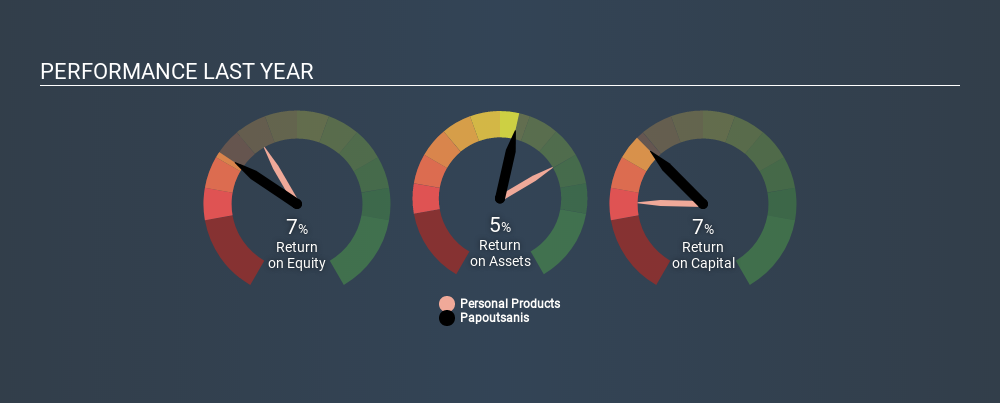
Therefore, Papoutsanis has an ROCE of 6.6%.
Check out our latest analysis for Papoutsanis
Is Papoutsanis's ROCE Good?
When making comparisons between similar businesses, investors may find ROCE useful. Using our data, Papoutsanis's ROCE appears to be significantly below the 12% average in the Personal Products industry. This performance could be negative if sustained, as it suggests the business may underperform its industry. Aside from the industry comparison, Papoutsanis's ROCE is mediocre in absolute terms, considering the risk of investing in stocks versus the safety of a bank account. Readers may find more attractive investment prospects elsewhere.
In our analysis, Papoutsanis's ROCE appears to be 6.6%, compared to 3 years ago, when its ROCE was 1.3%. This makes us think about whether the company has been reinvesting shrewdly. The image below shows how Papoutsanis's ROCE compares to its industry, and you can click it to see more detail on its past growth.
When considering ROCE, bear in mind that it reflects the past and does not necessarily predict the future. ROCE can be deceptive for cyclical businesses, as returns can look incredible in boom times, and terribly low in downturns. ROCE is only a point-in-time measure. How cyclical is Papoutsanis? You can see for yourself by looking at this free graph of past earnings, revenue and cash flow.
Papoutsanis's Current Liabilities And Their Impact On Its ROCE
Liabilities, such as supplier bills and bank overdrafts, are referred to as current liabilities if they need to be paid within 12 months. Due to the way the ROCE equation works, having large bills due in the near term can make it look as though a company has less capital employed, and thus a higher ROCE than usual. To check the impact of this, we calculate if a company has high current liabilities relative to its total assets.
Papoutsanis has total assets of €40m and current liabilities of €8.8m. Therefore its current liabilities are equivalent to approximately 22% of its total assets. It is good to see a restrained amount of current liabilities, as this limits the effect on ROCE.
Our Take On Papoutsanis's ROCE
If Papoutsanis continues to earn an uninspiring ROCE, there may be better places to invest. Of course, you might find a fantastic investment by looking at a few good candidates. So take a peek at this free list of companies with modest (or no) debt, trading on a P/E below 20.
I will like Papoutsanis better if I see some big insider buys. While we wait, check out this free list of growing companies with considerable, recent, insider buying.
If you spot an error that warrants correction, please contact the editor at editorial-team@simplywallst.com. This article by Simply Wall St is general in nature. It does not constitute a recommendation to buy or sell any stock, and does not take account of your objectives, or your financial situation. Simply Wall St has no position in the stocks mentioned.
We aim to bring you long-term focused research analysis driven by fundamental data. Note that our analysis may not factor in the latest price-sensitive company announcements or qualitative material. Thank you for reading.
MI

The Foxhole
Moderna nearly tripled overnight, and every other mRNA stock jumped with it. I think that could be a trap.

1810
QU
Quantanium
Did anyone else notice this narrative (posted over a year ago) was spot on with Moderna’s stock price!!! 🤯
PR
pri_dlp7z
Happy for the melanoma patients. It is no surprise that other companies moved up too. It's the optionality getting priced in.
About ATSE:PAP
Papoutsanis
Engages in the production and sale of soaps and liquid cosmetics in Greece.
Adequate balance sheet and slightly overvalued.
Market Insights


Advertisement
Weekly Picks
RI


Rick_Orford on Starfighters Space ·
The 1960s Fighter Jet That Could Crack Open a $20 Billion Satellite Market
Fair Value:US$520.4% undervalued
55 followersusers have followed this narrative
3 commentsusers have commented on this narrative
7 likesusers have liked this narrative
JO


John_Eric on MercadoLibre ·
MercadoLibre and the Spreadsheet Trick That Decides Everything
Fair Value:US$7.31k73.7% undervalued
102 followersusers have followed this narrative
2 commentsusers have commented on this narrative
16 likesusers have liked this narrative
RC

rcb9 on PayPal Holdings ·
Ten Percent More Volume, One Percent More Transaction Margin
Fair Value:US$70.8912.1% undervalued
15 followersusers have followed this narrative
1 commentusers have commented on this narrative
6 likesusers have liked this narrative
HE


HedgeY on Micron Technology ·
Micron - The Memory Bottleneck Behind the AI Supercycle
Fair Value:US$1.25k22.1% undervalued
39 followersusers have followed this narrative
0 commentsusers have commented on this narrative
13 likesusers have liked this narrative
Recently Updated Narratives
DA

danmad on CSL ·
Strong buy. World-leading healthcare company with steady growth
Fair Value:AU$21018.5% undervalued
28 followersusers have followed this narrative
0 commentsusers have commented on this narrative
0 likesusers have liked this narrative
HA


HarishPK on EverQuote ·
EverQuote and an Asymmetric Investment Opportunity
Fair Value:US$36.0831.0% undervalued
2 followersusers have followed this narrative
1 commentusers have commented on this narrative
0 likesusers have liked this narrative
RI

richard_53rym on Nintendo ·
Nintendo facing the Ram shortage situation
Fair Value:JP¥9.62k8.7% undervalued
4 followersusers have followed this narrative
0 commentsusers have commented on this narrative
0 likesusers have liked this narrative
Popular Narratives
OS


oscargarcia on NVIDIA ·
The company that went from selling GPUs to gamers to becoming the AI arms dealer of the 21st century.
Fair Value:US$28022.6% undervalued
334 followersusers have followed this narrative
9 commentsusers have commented on this narrative
16 likesusers have liked this narrative
CU

CubanEros on Microsoft ·
A wonderful business at reasonable price.
Fair Value:US$419.9114.6% overvalued
185 followersusers have followed this narrative
0 commentsusers have commented on this narrative
9 likesusers have liked this narrative
KI

KiwiInvest on Amazon.com ·
Amazon's high growth, high tech segments propel its profits, while traditional segments plod along
Fair Value:US$475.0945.3% undervalued
212 followersusers have followed this narrative
1 commentusers have commented on this narrative
8 likesusers have liked this narrative
Trending Discussion
JO
johnk72 on Global X AI Infrastructure ETF ·
Great picks & shovels investment. I hold 3,000 units with a plan to hold until the end of 2028
2
|0
