

Last Update 15 Apr 26
SBLK: Future Returns Will Depend On P/E, Margins And Capital Returns
Analysts have raised their price target on Star Bulk Carriers by $3, citing updated assumptions around the discount rate, revenue trajectory, profit margin and future P/E as the main drivers of the change.
Analyst Commentary
Bearish analysts are treating the higher price target as a fine tuning exercise rather than a shift in the overall risk profile. The updated assumptions around the discount rate, revenue trajectory, profit margin and future P/E keep the focus on execution risk and how the company might perform through different freight and rate cycles.
Bearish Takeaways
- Some bearish analysts highlight that the higher price target still reflects uncertainty around long term revenue visibility, especially if shipping demand or fleet utilization does not match current assumptions.
- There is concern that profit margin expectations could be sensitive to operating cost inflation and future charter rate conditions, which may make it harder for Star Bulk Carriers to consistently meet the earnings implied by the updated target.
- Cautious views point to the reliance on future P/E assumptions that could prove demanding if earnings growth stalls or if the market assigns a lower multiple to dry bulk names over time.
- Bearish analysts also flag execution risks around capital allocation and balance sheet management, warning that missteps on vessel spending or leverage could pressure valuation even if the new price target appears supportive today.
What's in the News
- On February 25, 2026, the Board of Directors authorized a share repurchase program allowing Star Bulk Carriers to buy back up to US$100 million of its own shares, with 111,530,150 shares outstanding as of that date (Key Developments).
- From October 1, 2025 to February 25, 2026, the company repurchased 3,176,543 shares for US$62.49 million, representing 2.78% of shares, and reported total repurchases of 3,183,948 shares for US$62.5 million under the buyback announced on August 6, 2025 (Key Developments).
- On February 25, 2026, the Board declared a quarterly cash dividend of US$0.37 per share, payable on or about March 19, 2026, to shareholders of record as of March 9, 2026 (Key Developments).
Valuation Changes
- Fair Value: The fair value estimate is unchanged at $25.90, so the higher price target reflects tweaks to inputs rather than a different central valuation point.
- Discount Rate: The discount rate has fallen slightly from 10.55% to about 10.50%, a small move that marginally raises the present value of projected cash flows.
- Revenue Growth: Long term revenue growth assumptions point to a slight 2.07% annual decline, adjusted modestly to a 2.05% annual decline, indicating only a minimal shift in expected top line trends.
- Net Profit Margin: The assumed net profit margin has risen slightly from about 35.74% to roughly 36.15%, signaling a modestly stronger profitability profile in the model.
- Future P/E: The future P/E assumption has edged down from about 9.70x to roughly 9.57x, implying a slightly more conservative multiple on Star Bulk Carriers’ forward earnings in the updated framework.
Key Takeaways
- Decarbonization trends and supply chain localization threaten core revenue streams, shrinking Star Bulk's market and pressuring growth prospects.
- An aging fleet and slow modernization risk higher operating costs and reduced competitiveness, magnifying profitability challenges and hurting long-term returns.
- Cost synergies, fleet modernization, and reduced debt position Star Bulk for improved profitability and competitiveness as tighter regulations and modest industry growth support freight rates.
Catalysts
About Star Bulk Carriers- A shipping company, engages in the ocean transportation of dry bulk cargoes through the ownership and operation of dry bulk carrier vessels worldwide.
- The accelerating global shift toward decarbonization and energy transition is set to steadily erode long-term demand for seaborne transportation of coal, iron ore, and other fossil fuel-related cargoes, which represent a significant portion of Star Bulk Carriers' revenues. This secular decline in core cargo volumes is likely to suppress top-line growth and lead to recurring pressure on long-term company revenue.
- Major economies are increasingly prioritizing localized manufacturing and supply chain resiliency, reflected in policy shifts toward nearshoring and reshoring production. As a result, the addressable market for global seaborne bulk trade is likely to shrink structurally, leading to reductions in vessel utilization rates and day rates, which will negatively impact Star Bulk's revenue and earnings power over the next decade.
- Star Bulk's aging fleet, with an average age of nearly 12 years, faces escalating capital expenditure requirements for retrofitting or replacement to comply with tightening environmental regulations. As the International Maritime Organization introduces stricter greenhouse gas emissions targets and fuel intensity standards, recurring high CapEx and increased depreciation will depress operating margins and erode long-term return on assets.
- Heavy reliance on global commodity cycles exposes Star Bulk to volatility in freight rates and charter markets. With projected contractions in bulk trade volumes for iron ore, coal, and grains in the coming years, combined with persistent overcapacity in the dry bulk shipping sector due to sluggish demolition of older vessels, there is a severe risk of suppressed profitability and earnings through recurring market downturns.
- Anticipated ramp-up of digitalization and operational efficiency among competitors, coupled with adoption of larger, more fuel-efficient vessels industrywide, could outpace Star Bulk's current fleet renewal efforts and push operating costs higher relative to peers. This competitive disadvantage will compress margins and erode Star Bulk Carriers' earnings unless dramatic reinvestment occurs, which would further pressure free cash flow and long-term shareholder returns.
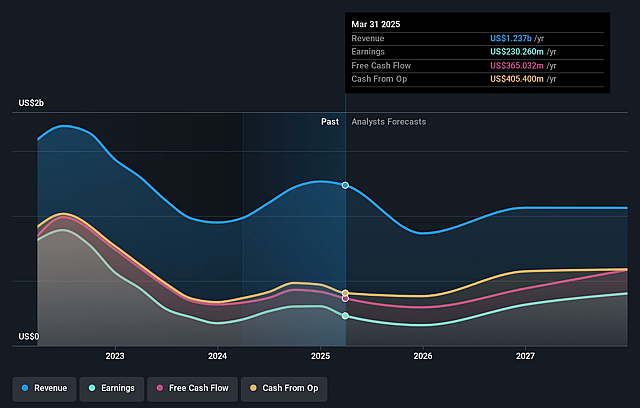
Star Bulk Carriers Future Earnings and Revenue Growth
Assumptions
How have these above catalysts been quantified?
- This narrative explores a more pessimistic perspective on Star Bulk Carriers compared to the consensus, based on a Fair Value that aligns with the bearish cohort of analysts.
- The bearish analysts are assuming Star Bulk Carriers's revenue will decrease by 2.0% annually over the next 3 years.
- The bearish analysts assume that profit margins will increase from 8.1% today to 36.2% in 3 years time.
- The bearish analysts expect earnings to reach $354.2 million (and earnings per share of $3.18) by about April 2029, up from $84.2 million today. However, there is some disagreement amongst the analysts with the more bullish ones expecting earnings as high as $630.2 million.
- In order for the above numbers to justify the price target of the more bearish analyst cohort, the company would need to trade at a PE ratio of 9.6x on those 2029 earnings, down from 32.6x today. This future PE is greater than the current PE for the US Shipping industry at 8.2x.
- The bearish analysts expect the number of shares outstanding to decline by 4.5% per year for the next 3 years.
- To value all of this in today's terms, we will use a discount rate of 10.5%, as per the Simply Wall St company report.
Risks
What could happen that would invalidate this narrative?- The company has achieved nearly $40 million in cost synergies from the Eagle Bulk integration, with significant reductions in operating expenses, dry dock costs, and interest expenses, which are likely to support profitability and net margins even in a challenging market environment.
- Star Bulk has been actively deleveraging, reducing its average net debt per vessel by over 50% since 2021 and now holds a net debt position covered by fleet scrap value, greatly strengthening its balance sheet and lowering financial risk, which supports future earnings and dividends.
- The company is modernizing its fleet by disposing less efficient, older vessels and investing in new eco-friendly ships and energy-saving retrofits, a strategy that should enhance fleet efficiency, reduce operating costs, and help safeguard future net margins and vessel utilization as regulations tighten.
- Supply discipline in the industry is evident, with the global order book at multi-year lows, high newbuilding costs, uncertainty around future fuel technologies, and limited shipyard capacity, all of which are expected to keep fleet growth modest and tighten supply-demand balance, providing potential upside to vessel charter rates and Star Bulk's revenue.
- Regulatory changes, such as the new IMO greenhouse gas fuel intensity metric and stricter emission targets, may incentivize slow steaming and support higher freight rates for compliant operators like Star Bulk, giving them a competitive advantage and potentially boosting long-term revenue and earnings.
Valuation
How have all the factors above been brought together to estimate a fair value?
- The assumed bearish price target for Star Bulk Carriers is $25.9, which represents up to two standard deviations below the consensus price target of $29.73. This valuation is based on what can be assumed as the expectations of Star Bulk Carriers's future earnings growth, profit margins and other risk factors from analysts on the more bearish end of the spectrum.
- However, there is a degree of disagreement amongst analysts, with the most bullish reporting a price target of $33.0, and the most bearish reporting a price target of just $25.9.
- In order for you to agree with the more bearish analyst cohort, you'd need to believe that by 2029, revenues will be $979.7 million, earnings will come to $354.2 million, and it would be trading on a PE ratio of 9.6x, assuming you use a discount rate of 10.5%.
- Given the current share price of $24.58, the analyst price target of $25.9 is 5.1% higher. The relatively low difference between the current share price and the analyst consensus price target indicates that they believe on average, the company is fairly priced.
- We always encourage you to reach your own conclusions though. So sense check these analyst numbers against your own assumptions and expectations based on your understanding of the business and what you believe is probable.
Have other thoughts on Star Bulk Carriers?
Create your own narrative on this stock, and estimate its Fair Value using our Valuator tool.
Create NarrativeHow well do narratives help inform your perspective?
Disclaimer
AnalystLowTarget is a tool utilizing a Large Language Model (LLM) that ingests data on consensus price targets, forecasted revenue and earnings figures, as well as the transcripts of earnings calls to produce qualitative analysis. The narratives produced by AnalystLowTarget are general in nature and are based solely on analyst data and publicly-available material published by the respective companies. These scenarios are not indicative of the company's future performance and are exploratory in nature. Simply Wall St has no position in the company(s) mentioned. Simply Wall St may provide the securities issuer or related entities with website advertising services for a fee, on an arm's length basis. These relationships have no impact on the way we conduct our business, the content we host, or how our content is served to users. The price targets and estimates used are consensus data, and do not constitute a recommendation to buy or sell any stock, and they do not take account of your objectives, or your financial situation. Note that AnalystLowTarget's analysis may not factor in the latest price-sensitive company announcements or qualitative material.


