

Last Update 17 Jul 26
Fair value Increased 15%JNJ: Oncology Focus And New Medicines Will Drive Confidence Through 2026
Analysts raised the Johnson & Johnson fair value estimate to $305 from $265 after a series of price target increases tied to a recent quarterly beat, higher full year guidance, and growing confidence in the company's new medicines and projected revenue trajectory through 2026.
Analyst Commentary
Recent Street research around Johnson & Johnson has turned more constructive, with a cluster of upgrades and higher price targets following the latest quarterly results and revised guidance. Bullish analysts are reacting to what they describe as strong execution on new medicines, a solid contribution from key pharmaceutical products, and a clearer multi year revenue roadmap through 2026.
Several firms that were previously more cautious have shifted to a more positive stance, pointing to Johnson & Johnson's updated full year revenue and EPS guidance, as well as management commentary about the trajectory of its product portfolio. At the same time, large global banks such as Goldman Sachs, Morgan Stanley, JPMorgan, HSBC, Citi, and others have adjusted their models and targets, reinforcing a view that the stock's risk reward profile has improved following the recent quarter.
Across the reports, the common threads are the strength of the Innovative Medicine franchise, expectations around the ramp of newer drugs like Tremfya and Icotyde, and a perception that MedTech trends are generally stable even where certain segments, such as Abiomed or cardio related products, were described as soft. Analysts also continue to track policy risks, including potential Medicare drug price negotiations, but so far regard diversification and legal processes as important offsets rather than core reasons to avoid the stock.
In aggregate, this flow of research has fed into higher fair value estimates and price objectives for Johnson & Johnson, with many targets now clustered in the mid to high US$200s and some stretching to US$300 and above. Investors weighing the stock are therefore seeing a backdrop of broadly constructive Street sentiment, informed by both the latest reported numbers and company specific commentary on its pipeline and revenue goals.
Bullish Takeaways
- Multiple bullish analysts have raised Johnson & Johnson price targets into a US$260 to above US$300 range. This aligns with the higher fair value estimate and reflects growing comfort with execution on revenue and earnings guidance through 2026.
- Several upgrades and Buy or Overweight ratings are tied directly to what analysts describe as strong quarterly performance, robust Innovative Medicine revenue, and the contribution from newer drugs such as Tremfya, Spravato, Caplyta, Rybrevant, Icotyde, and Inlexzo, which they see as important drivers of the growth story.
- Major firms including Goldman Sachs, Morgan Stanley, RBC Capital, HSBC, Citi, TD Cowen, and JPMorgan have lifted targets after the recent Q2 beat and raised guidance, citing solid enterprise level growth, a supportive MedTech procedure backdrop, and generally stable demand in core healthcare markets.
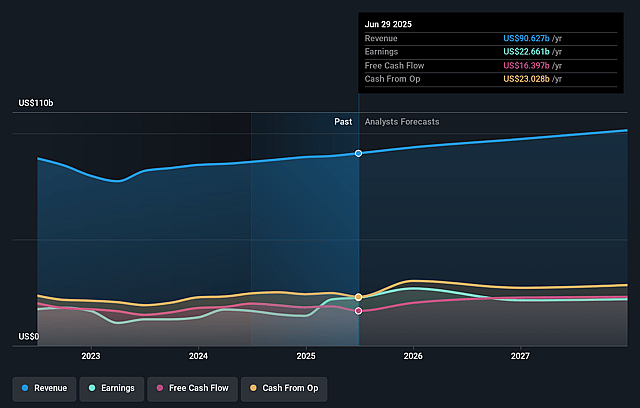
- Some bullish analysts explicitly reference confidence in Johnson & Johnson's ability to work toward double digit revenue growth later in the decade and to move toward or beyond US$100b in revenue by 2026. They view this as supportive of higher long term valuation multiples if the company continues to execute.
What’s in the News for Johnson & Johnson
- Johnson & Johnson reported Q2 2026 revenue of about US$25.3b, up 6.6% year over year, with adjusted EPS of US$2.90. The company raised full year sales guidance to above US$100b for the first time in its history, supported by the Innovative Medicine and MedTech segments (Source: Johnson & Johnson Surpasses $100 Billion Revenue Milestone, Raises 2026 Outlook on Strong Q2 Results).
- The company reaffirmed its focus on oncology and neuroscience rather than entering the obesity drug market. It is targeting the No. 1 global oncology position by 2030 and has cited a US$50b cancer sales goal alongside US$55b of planned US investment over four years, including new biologics manufacturing capacity (Source: Johnson & Johnson Skips Obesity Drug Race to Focus on Leading Cancer Market by 2030).
- Legal risk remains in focus after an Illinois appellate court upheld a US$45m mesothelioma verdict related to historical talc products. The ruling affirmed successor liability for Kenvue and Johnson & Johnson Holdco and may shape expectations for other talc related cases (Source: Illinois Appellate Court Upholds $45 Million Mesothelioma Verdict Against Johnson & Johnson).
- On the product side, Johnson & Johnson received U.S. FDA approval for its Dual Energy THERMOCOOL SMARTTOUCH SF catheter ablation platform. The approval allows electrophysiologists to use both radiofrequency and pulsed field energy in a single catheter and supports a phased commercial rollout starting this summer (Source: Key Developments, Product Related Announcements, DE STSF Platform).
- In autoimmune and rare disease, IMAAVY (nipocalimab) is a key news driver, with new late stage data in generalized myasthenia gravis and warm autoimmune hemolytic anemia, FDA Priority Review in wAIHA, and multiple Fast Track, Breakthrough Therapy and orphan designations across indications. These developments reinforce Johnson & Johnson’s push into FcRn targeted therapies (Sources: Johnson & Johnson Advances IMAAVY Pipeline with New Data and Strong Market Response; Key Developments, multiple IMAAVY announcements).
Valuation Changes for Johnson & Johnson
- Fair Value: Raised from $265 to $305, indicating a higher assessed intrinsic value per share.
- Discount Rate: Increased from 6.956% to 7.108%, indicating a slightly higher required return in the valuation model.
- Revenue Growth: Assumed long-term revenue growth rate increased from 7.10% to 8.66%, reflecting a stronger modeled top-line trajectory for Johnson & Johnson.
- Net Profit Margin: Target profit margin moved from 22.64% to 23.56%, indicating a modestly higher expected level of profitability in future years.
- Future P/E: Forward P/E multiple used in the model increased from 29.88x to 32.11x, resulting in a higher valuation framework for the stock.
Catalysts
About Johnson & Johnson
Johnson & Johnson is a global health care company that develops and sells pharmaceuticals and medical devices across Oncology, Immunology, Neuroscience, Cardiovascular, Surgery and Vision.
What are the underlying business or industry changes driving this perspective?
- Scaling across 28 platforms or products, each generating at least US$1b in annual revenue, with multiple brands such as DARZALEX, TREMFYA, CARVYKTI, ERLEADA and SPRAVATO already at high run rates, supports a broad base for potential future revenue and earnings growth rather than reliance on a single product.
- Heavy investment in drug discovery and deal making, with more than US$32b in 2025 allocated to R&D and M&A plus 51 approvals, 32 submissions and 11 new Phase III programs, sets up a sizeable pipeline that could feed future revenue and help sustain or expand net margins as higher value products mature.
- Growth in complex therapies that address high unmet medical need, including multiple myeloma treatments (DARZALEX, CARVYKTI, TECVAYLI, TALVEY), ICOTYDE in Immunology, and CAPLYTA and SPRAVATO in Neuroscience, positions J&J in areas where pricing power and treatment duration can be supportive for long term revenue and earnings.
- Rapid expansion in Cardiovascular and electrophysiology, with Abiomed, Shockwave, VARIPULSE and a planned cadence of at least one new pulsed field ablation catheter each year plus regular CARTO mapping upgrades, supports procedure growth and a richer mix of MedTech revenue that can lift segment margins and total company operating margin.
- Advances in Surgery and Vision, including MONARCH’s move into urology, the OTTAVA robotic surgery system, and premium eye products like TECNIS Odyssey and TECNIS PureSee along with ACUVUE OASYS MAX, target procedure efficiency and premium categories that can support higher average selling prices, contributing to revenue growth and improved earnings leverage.
Assumptions
How have these above catalysts been quantified?
- This narrative explores a more optimistic perspective on Johnson & Johnson compared to the consensus, based on a Fair Value that aligns with the bullish cohort of analysts.
- The bullish analysts are assuming Johnson & Johnson's revenue will grow by 8.7% annually over the next 3 years.
- The bullish analysts assume that profit margins will increase from 21.5% today to 23.6% in 3 years time.
- The bullish analysts expect earnings to reach $29.6 billion (and earnings per share of $13.84) by about July 2029, up from $21.0 billion today. However, there is some disagreement amongst the analysts with the more bearish ones expecting earnings as low as $22.8 billion.
- In order for the above numbers to justify the price target of the more bullish analyst cohort, the company would need to trade at a PE ratio of 32.1x on those 2029 earnings, up from 28.6x today. This future PE is greater than the current PE for the US Pharmaceuticals industry at 15.1x.
- The bullish analysts expect the number of shares outstanding to grow by 1.32% per year for the next 3 years.
- To value all of this in today's terms, we will use a discount rate of 7.11%, as per the Simply Wall St company report.
Risks
What could happen that would invalidate this narrative?
- The long term reliance on a small group of blockbuster drugs and devices, such as DARZALEX at over US$14b in annual sales and other multi billion dollar brands, increases exposure to patent expiries, biosimilar or generic competition and competing therapies. This could pressure revenue concentration and weaken earnings if replacement assets do not scale quickly enough.
- Ongoing and emerging pricing pressures, including U.S. government agreements to improve access and lower medicine costs, Part D redesign effects on products like ERLEADA and STELARA, and volume based procurement in China across Surgery and Orthopaedics, create a structural headwind for drug and device pricing. This could compress net margins and slow earnings growth.
- Higher structural cost burdens from tariffs in MedTech, a higher average debt balance that has already reduced net interest income, and continued heavy R&D and capital investment including new U.S. manufacturing facilities, increase the fixed cost base and financial risk if revenue growth slows. This could limit operating margin expansion and free cash flow.
- Large scale acquisitions and pipeline bets, including Intra Cellular Therapies, Halda Therapeutics and the portfolio of high cost late stage programs, carry integration, execution and clinical risk. Any underperformance, delays or safety issues could mean the acquired assets do not offset losses from products facing loss of exclusivity, putting pressure on long term revenue and earnings.
- Persistent legal and regulatory exposure, highlighted by the talc litigation and higher litigation costs of US$0.9b in Q4 2025 as well as the planned separation of the Orthopaedics business, could lead to additional settlements, adverse rulings, higher compliance costs or stranded costs. These outcomes would directly affect net income and constrain capital available for growth investments.
Valuation
How have all the factors above been brought together to estimate a fair value?
- The assumed bullish price target for Johnson & Johnson is $305.0, which represents up to two standard deviations above the consensus price target of $269.95. This valuation is based on what can be assumed as the expectations of Johnson & Johnson's future earnings growth, profit margins and other risk factors from analysts on the bullish end of the spectrum.
- However, there is a degree of disagreement amongst analysts, with the most bullish reporting a price target of $305.0, and the most bearish reporting a price target of just $190.0.
- In order for you to agree with the more bullish analyst cohort, you'd need to believe that by 2029, revenues will be $125.7 billion, earnings will come to $29.6 billion, and it would be trading on a PE ratio of 32.1x, assuming you use a discount rate of 7.1%.
- Given the current share price of $249.97, the analyst price target of $305.0 is 18.0% higher.
- We always encourage you to reach your own conclusions though. So sense check these analyst numbers against your own assumptions and expectations based on your understanding of the business and what you believe is probable.
Have other thoughts on Johnson & Johnson?
Create your own narrative on this stock, and estimate its Fair Value using our Valuator tool.
Create NarrativeHow well do narratives help inform your perspective?
Comments
0 commentsDisclaimer
AnalystHighTarget is a tool utilizing a Large Language Model (LLM) that ingests data on consensus price targets, forecasted revenue and earnings figures, as well as the transcripts of earnings calls to produce qualitative analysis. The narratives produced by AnalystHighTarget are general in nature and are based solely on analyst data and publicly-available material published by the respective companies. These scenarios are not indicative of the company's future performance and are exploratory in nature. Simply Wall St has no position in the company(s) mentioned. Simply Wall St may provide the securities issuer or related entities with website advertising services for a fee, on an arm's length basis. These relationships have no impact on the way we conduct our business, the content we host, or how our content is served to users. The price targets and estimates used are consensus data, and do not constitute a recommendation to buy or sell any stock, and they do not take account of your objectives, or your financial situation. Note that AnalystHighTarget's analysis may not factor in the latest price-sensitive company announcements or qualitative material.


