

Last Update 12 Jun 26
Fair value Increased 32%SBLK: Q1 Earnings Beat And Capital Returns Will Support Future Upside
Analysts have raised their price target on Star Bulk Carriers from $23.43 to $30.98, citing recent bullish research and an improving dry bulk market following the Q1 earnings beat.
Analyst Commentary
Recent research on Star Bulk Carriers focuses on how the company is positioned after its Q1 earnings beat and what that might mean for valuation and execution in an improving dry bulk market.
Bullish Takeaways
- Bullish analysts are raising price targets, including one move to US$32, which signals increased confidence in how the current earnings profile lines up with the stock's valuation.
- The Q1 earnings beat is seen as evidence that the company is executing well against current dry bulk conditions, supporting a more constructive view on future cash generation and balance sheet flexibility.
- Commentary points to an improving dry bulk market after Q1, which bullish analysts view as a supportive backdrop for vessel utilization and freight rate realization.
- Initiation with a positive stance from research coverage suggests that more of the market is starting to pay attention to the story, which can matter for liquidity and how quickly new information is reflected in the share price.
Bearish Takeaways
- Higher price targets after an earnings beat can compress the margin of safety, so investors may want to be disciplined about entry points and not rely only on recent research optimism.
- The thesis is heavily tied to conditions in the dry bulk market, which can change, so any cooling in freight activity could challenge the more constructive assumptions that current targets are based on.
- With expectations reset higher following the Q1 beat, there is less room for execution missteps in future quarters without putting pressure on the stock's perceived fair value.
- New bullish coverage may increase enthusiasm, but it does not change operational or market risks, so position sizing and diversification remain important for risk management.
What's in the News
- Star Bulk Carriers reported Q1 2026 net income of US$58.5 million and earnings per share of US$0.56, with revenues of US$281.15 million, supported by what reports describe as a robust dry bulk market and improved fleet utilization. (Source: Recent Q1 2026 earnings coverage)
- The company declared a quarterly dividend of US$0.50 per share for Q1 2026, which reports describe as a 35.1% increase, and confirmed a full payout policy tied to free cash flow, with the dividend payable on June 22, 2026. (Sources: Recent Q1 2026 earnings coverage, company dividend announcement)
- Star Bulk Carriers announced a US$100 million share buyback authorization alongside its Q1 2026 results, signaling an additional capital return tool alongside the dividend program. (Source: Recent Q1 2026 earnings coverage)
- Management reported progress on an eight vessel newbuilding program focused on modern, fuel efficient Kamsarmax ships with scrubbing technology, along with two vessel sales that generated about US$46.4 million and refinancing agreements aimed at supporting fleet efficiency and financial flexibility. (Source: Recent Q1 2026 earnings coverage)
- Following the Q1 2026 report, news coverage highlighted that the stock reached a 52 week high of US$28.30 and that Deutsche Bank and Jefferies raised their price targets to US$32 and US$31, respectively, while Zacks assigned a Rank #1 (Strong Buy) rating. (Sources: Recent Q1 2026 earnings coverage and analyst recap)
Valuation Changes
- Fair Value: The updated estimate has risen from $23.43 to $30.98 per share, representing a sizeable upward reset in the modeled value.
- Discount Rate: The assumed discount rate has fallen slightly from 11.04% to 10.19%, indicating a modest change in the required return used in the analysis.
- Revenue Growth: The revenue growth input has shifted from 81.80% to a decline of 101.76%, reflecting a move from strong growth assumptions to a steep contraction assumption.
- Net Profit Margin: The modeled net profit margin has eased from 53.07% to 50.11%, which remains high but reflects a small reduction in expected profitability on each dollar of revenue.
- Future P/E: The assumed future P/E multiple has increased from 5.84x to 8.04x, pointing to a higher valuation multiple applied to expected earnings.
Key Takeaways
- Fleet modernization and eco-upgrades position the company to capitalize on tighter emissions regulations and improved efficiency, supporting margin and earnings growth.
- Tight vessel supply, rising demand for key commodities, and disciplined capital allocation strategies are expected to drive strong fleet utilization and enhanced shareholder returns.
- Structural demand weakness, an aging fleet, high leverage, rising compliance costs, and volatile trade dynamics threaten long-term profitability and financial stability.
Catalysts
About Star Bulk Carriers- A shipping company, engages in the ocean transportation of dry bulk cargoes through the ownership and operation of dry bulk carrier vessels worldwide.
- The ongoing replacement of older, less efficient vessels with newbuilds and eco upgrades positions the fleet to benefit from tightening global emissions standards, enabling lower operating expenses and potential for higher charter rates, thereby supporting improved net margins and overall earnings.
- Limited new vessel supply, caused by a historically low orderbook, strong shipyard constraints, and uncertainty around future green technologies, should maintain a tight tonnage market through 2027-allowing Star Bulk to benefit from stronger utilization and higher time charter revenues.
- Global GDP growth revisions and renewed infrastructure spending, especially in emerging markets, are expected to revive demand for iron ore, steel, grains, and minor bulks-key commodities for dry bulk shipping-offering upside to fleet utilization and revenue growth.
- Active capital allocation-demonstrated through ongoing share buybacks and disciplined dividend payouts-optimizes EPS by reducing share count and supporting shareholder returns even during volatile market periods.
- Investments in digitalization, operational optimization, and new energy-saving technologies are set to reduce OpEx per vessel and enhance fleet productivity, boosting EBITDA margins and sustainable long-term profitability.
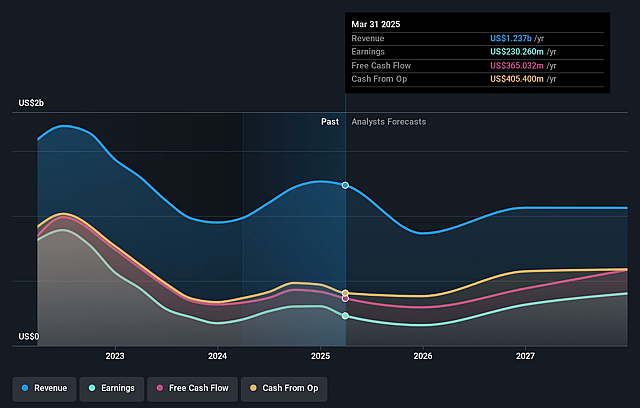
Star Bulk Carriers Future Earnings and Revenue Growth
Assumptions
How have these above catalysts been quantified?
- Analysts are assuming Star Bulk Carriers's revenue will decrease by 1.0% annually over the next 3 years.
- Analysts assume that profit margins will increase from 13.0% today to 50.1% in 3 years time.
- Analysts expect earnings to reach $531.1 million (and earnings per share of $3.95) by about June 2029, up from $142.2 million today. However, there is a considerable amount of disagreement amongst the analysts with the most bullish expecting $659.6 million in earnings, and the most bearish expecting $367.0 million.
- In order for the above numbers to justify the price target of the analysts, the company would need to trade at a PE ratio of 8.1x on those 2029 earnings, down from 21.3x today. This future PE is lower than the current PE for the US Shipping industry at 13.0x.
- Analysts expect the number of shares outstanding to decline by 2.43% per year for the next 3 years.
- To value all of this in today's terms, we will use a discount rate of 10.19%, as per the Simply Wall St company report.
Risks
What could happen that would invalidate this narrative?- Dry bulk trade growth is projected to be nearly flat, with 2025 volumes expected to contract by 0.9% and only marginal growth in subsequent years, signaling structural weakness in demand for Star Bulk's services and risking long-term revenue stagnation.
- The company has an aging fleet with an average age of 11.9 years, requiring ongoing and significant capital expenditures for vessel upgrades, dry docking, and compliance retrofits, likely compressing net margins and increasing capex relative to peers with newer fleets.
- Heavily relying on debt ($1.12 billion total debt against total cash of $407 million), Star Bulk's high leverage exposes it to higher financial risk, especially if interest rates rise or if freight rates drop, which would adversely affect earnings and balance sheet flexibility.
- Intensifying decarbonization and global environmental regulations (e.g., IMO 2028 and beyond) may drive up operational and compliance costs, particularly as the company still needs to invest in alternative fuel technologies and is only in the early stages of exploring these options, risking further margin erosion.
- Exposure to volatile commodity cycles and shifting global trade dynamics-such as the decline in Chinese dry bulk imports, contracting coal trade, and uncertainties from tariffs-may cause unpredictable cash flows and earnings volatility, undermining long-term financial stability and investor returns.
Valuation
How have all the factors above been brought together to estimate a fair value?
- The analysts have a consensus price target of $30.98 for Star Bulk Carriers based on their expectations of its future earnings growth, profit margins and other risk factors.
- However, there is a degree of disagreement amongst analysts, with the most bullish reporting a price target of $33.0, and the most bearish reporting a price target of just $25.9.
- In order for you to agree with the analysts, you'd need to believe that by 2029, revenues will be $1.1 billion, earnings will come to $531.1 million, and it would be trading on a PE ratio of 8.1x, assuming you use a discount rate of 10.2%.
- Given the current share price of $27.15, the analyst price target of $30.98 is 12.4% higher.
- We always encourage you to reach your own conclusions though. So sense check these analyst numbers against your own assumptions and expectations based on your understanding of the business and what you believe is probable.
Have other thoughts on Star Bulk Carriers?
Create your own narrative on this stock, and estimate its Fair Value using our Valuator tool.
Create NarrativeHow well do narratives help inform your perspective?
Disclaimer
AnalystConsensusTarget is a tool utilizing a Large Language Model (LLM) that ingests data on consensus price targets, forecasted revenue and earnings figures, as well as the transcripts of earnings calls to produce qualitative analysis. The narratives produced by AnalystConsensusTarget are general in nature and are based solely on analyst data and publicly-available material published by the respective companies. These scenarios are not indicative of the company's future performance and are exploratory in nature. Simply Wall St has no position in the company(s) mentioned. Simply Wall St may provide the securities issuer or related entities with website advertising services for a fee, on an arm's length basis. These relationships have no impact on the way we conduct our business, the content we host, or how our content is served to users. The price targets and estimates used are consensus data, and do not constitute a recommendation to buy or sell any stock, and they do not take account of your objectives, or your financial situation. Note that AnalystConsensusTarget's analysis may not factor in the latest price-sensitive company announcements or qualitative material.


