
Last Update 05 Aug 26
Fair value Increased 9.25%RBA: Fair Value Reset With Governance And Capital Deployment As Key Tests
Analysts have lifted the Restaurant Brands Asia fair value estimate from about ₹83.80 to roughly ₹91.56, reflecting updated assumptions on the discount rate, growth and margins that align with recent Street research highlighting reworked targets and expectations in related consumer and retail groups.
Analyst Commentary
Recent Street commentary on related consumer and retail groups provides some useful read across for Restaurant Brands Asia. While the research is centered on RB Global in the auto retail and auction space, the way bullish and bearish analysts frame growth, execution and valuation helps put Restaurant Brands Asia's refreshed fair value into context.
Bullish Takeaways
- Bullish analysts point to companies that are adding share in their core markets, supported by contract wins and volume ramps. For Restaurant Brands Asia, similar share gains in key regions would help support the higher fair value input assumptions on growth and margins.
- Street research highlights stocks that combine organic expansion with M&A pipelines. Investors may look for Restaurant Brands Asia to show a clear roadmap on new store openings and potential partnerships or acquisitions that could justify stronger long run cash flow assumptions.
- Analysts in comparable sectors respond positively to clear capital allocation frameworks, including buybacks and disciplined reinvestment. If Restaurant Brands Asia can outline a consistent policy on reinvestment versus returns to shareholders, that could support confidence around the discount rate and terminal value used in valuation models.
- Research notes flag earnings periods as catalysts when new contracts begin to show up in reported volumes. For Restaurant Brands Asia, visible translation of development agreements and new format rollouts into revenue and margin contribution would help close any gap between intrinsic value estimates and market pricing.
Bearish Takeaways
- Bearish analysts trim price targets even when they keep positive ratings if near term earnings visibility looks mixed or if sector assumptions are being recalibrated. Restaurant Brands Asia could see similar caution if input costs, competitive intensity or consumer demand introduce uncertainty around the updated growth and margin assumptions.
- Street commentary also highlights the risk that share gains in one part of a business may not fully offset pressure elsewhere. For Restaurant Brands Asia, slower than expected traction in certain regions or formats could weigh on the valuation if it leads to lower unit economics than assumed.
- Some research stresses that market prices may already discount future contract wins or expansion. Investors in Restaurant Brands Asia should be mindful that high expectations embedded in fair value estimates leave less room for execution missteps or delays in store ramp up.
- Analysts sometimes flag capital allocation shifts as a double edged sword if they reduce financial flexibility. If Restaurant Brands Asia commits to heavy expansion or higher leverage without a clear payback profile, the discount rate used in models could move higher, which would pressure fair value even if revenue continues to grow.
What’s in the News for Restaurant Brands Asia
- On July 7, 2026, Aayush Madhusudan Agrawal, Lenexis FoodWorks Private Limited, Inspira Realty 1 Private Limited and Inspira Agro Trading LLC completed the acquisition of an 8.20% stake in Restaurant Brands Asia Limited from Qsr Asia Pte Ltd. and F&B Asia Ventures (Singapore) Pte. Ltd. for about ₹4.6b in cash, following a mandatory open offer and required regulatory approvals. Source: M&A transaction closing disclosure.
- Following this transaction, Inspira Global holds 41.78% of Restaurant Brands Asia Limited, which places a large block of the company with a single shareholder group. Source: M&A transaction closing disclosure.
- On June 19, 2026, Aayush Agrawal Trust, Aayush Madhusudan Agrawal, Lenexis FoodWorks Private Limited and Inspira Foodworks Private Limited completed the acquisition of a 12.88% stake in Restaurant Brands Asia Limited for about ₹7.2b in cash at an offer price of ₹70 per share. Source: open offer completion disclosure.
- On July 7, 2026, the board of Restaurant Brands Asia Limited met to review the share acquisition by the new investor group, changes in the promoter and promoter group, resignations of existing non executive non independent directors, appointments of new non executive non independent directors and a change in the chairman of the board. Source: board meeting agenda.
- A board meeting is scheduled for August 3, 2026 to review unaudited standalone and consolidated results for the quarter ended June 30, 2026 and to consider an investment of up to IDR 100b in PT Sari Burger Indonesia through subscription to up to 100,000 redeemable cumulative non convertible preference shares with a face value of IDR 1,000,000 each. Source: board meeting notice and proposed investment details.
Valuation Changes for Restaurant Brands Asia
- Fair Value has moved from about ₹83.80 to roughly ₹91.56, which represents a modest upward reset in the intrinsic value estimate for Restaurant Brands Asia.
- Discount Rate has been reduced slightly from about 16.19% to roughly 15.72%, reflecting updated assumptions on required returns.
- Revenue Growth has shifted from about 18.29% to roughly 15.90%, which suggests more measured top line expectations in the refreshed model.
- Net Profit Margin has been reworked from about 1.12% to roughly 15.91%, indicating a much higher margin profile in the updated assumptions for Restaurant Brands Asia.
- Future P/E has moved from about 152.49x to roughly 14.98x, which shows a very large reset in the valuation multiple used in the projections.
Key Takeaways
- Aggressive expansion into smaller Indian cities and digital adoption are enhancing reach, efficiency, and margins, fueling growth and customer engagement.
- Menu innovation, operational efficiencies, and international turnaround measures support sustained sales momentum and improved long-term profitability.
- Heavy promotional focus, aggressive expansion, and rising competition are pressuring margins, while weak premium sales signal challenges in boosting revenue and profitability.
Catalysts
About Restaurant Brands Asia- Together with its subsidiaries operates quick service restaurant chains in India and Indonesia.
- Expansion into underserved Tier II and III Indian cities and consistent addition of 60-80 new stores per year is growing Restaurant Brands Asia's addressable market, allowing it to capture rising urban demand and increase revenues and operating leverage.
- Rapid adoption of digital ordering (SOKs in 93% of stores, 90%+ sales from digital channels, and growing BK app penetration) is improving operational efficiency and customer engagement, which supports higher revenue growth and helps drive down cost-to-serve and lift net margins.
- Successful implementation of a value-driven barbell menu strategy and ongoing cafe rollout (now in 480+ locations) is driving consistent dine-in traffic, repeat business, and average ticket size improvements, supporting stable same-store sales growth and topline expansion.
- Ongoing upgrades in procurement, utilities, and rent negotiations-enabled by scale and technology investments-are leading to structurally lower cost lines (e.g., utilities, rents, IT costs), supporting improvement in EBITDA margins and long-term profitability.
- Margin-accretive turnaround initiatives in Indonesia (ADS growth, closure of underperforming stores, and reduction in corporate overheads) are positioning the international business for breakeven and future earnings contribution, complementing core India growth.
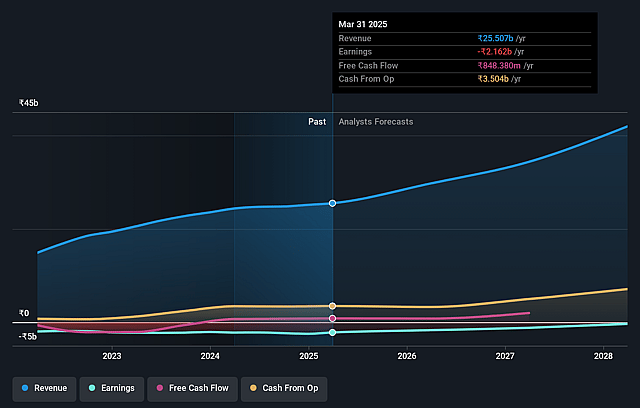
Restaurant Brands Asia Future Earnings and Revenue Growth
Assumptions
How have these above catalysts been quantified?
- Analysts are assuming Restaurant Brands Asia's revenue will grow by 15.9% annually over the next 3 years.
- Analysts are not forecasting that Restaurant Brands Asia will become profitable in next 3 years. To represent the Analyst Price Target as a Future PE Valuation we will estimate Restaurant Brands Asia's profit margin will increase from -5.9% to the average IN Hospitality industry of 15.9% in 3 years.
- If Restaurant Brands Asia's profit margin were to converge on the industry average, you could expect earnings to reach ₹7.3 billion (and earnings per share of ₹9.46) by about August 2029, up from -₹1.7 billion today.
- In order for the above numbers to justify the price target of the analysts, the company would need to trade at a PE ratio of 15.0x on those 2029 earnings, up from -36.0x today. This future PE is lower than the current PE for the IN Hospitality industry at 27.5x.
- Analysts expect the number of shares outstanding to grow by 7.0% per year for the next 3 years.
- To value all of this in today's terms, we will use a discount rate of 15.72%, as per the Simply Wall St company report.
Risks
What could happen that would invalidate this narrative?- Persistent softness and limited growth in premium menu categories, reflected by modest same-store sales growth (SSSG) of only 2.6%, may signal a lack of pricing power and consumer willingness to spend, potentially constraining revenue growth and gross margin expansion if this trend persists long-term.
- Heavy reliance on value-driven traffic growth and price-sensitive promotions (such as 2 for ₹79/99) may erode average ticket sizes, limit ability to pass on inflationary costs, and drive lower overall earnings quality over time if consumer downtrading becomes entrenched.
- The ongoing ramp-up of store count amid slow demand recovery and lower ADS (Average Daily Sales) in new stores, particularly in Indonesia and the newly launched cafes, risks margin dilution and operating inefficiency, which could negatively affect net margins if store productivity fails to keep pace with expansion.
- Rising operational complexities and costs, such as increased staffing/training to support digital initiatives and aggressive menu innovation, could escalate SG&A and labor costs and may outweigh savings from utilities and rent renegotiations in the near to medium term-pressuring net margins and earnings.
- Intensifying competition from global and local QSR players in both India and Indonesia, coupled with higher promotional intensity and the growing impact of food delivery platforms like Swiggy and Zomato, could further reduce footfall and force margin-eroding price actions, impacting both revenue growth and long-run profitability.
Valuation
How have all the factors above been brought together to estimate a fair value?
- The analysts have a consensus price target of ₹91.56 for Restaurant Brands Asia based on their expectations of its future earnings growth, profit margins and other risk factors.
- However, there is a degree of disagreement amongst analysts, with the most bullish reporting a price target of ₹120.0, and the most bearish reporting a price target of just ₹76.0.
- In order for you to agree with the analysts, you'd need to believe that by 2029, revenues will be ₹45.9 billion, earnings will come to ₹7.3 billion, and it would be trading on a PE ratio of 15.0x, assuming you use a discount rate of 15.7%.
- Given the current share price of ₹87.74, the analyst price target of ₹91.56 is 4.2% higher. The relatively low difference between the current share price and the analyst consensus price target indicates that they believe on average, the company is fairly priced.
- We always encourage you to reach your own conclusions though. So sense check these analyst numbers against your own assumptions and expectations based on your understanding of the business and what you believe is probable.
Have other thoughts on Restaurant Brands Asia?
Create your own narrative on this stock, and estimate its Fair Value using our Valuator tool.
Create NarrativeHow well do narratives help inform your perspective?
Comments
0 commentsDisclaimer
AnalystConsensusTarget is a tool utilizing a Large Language Model (LLM) that ingests data on consensus price targets, forecasted revenue and earnings figures, as well as the transcripts of earnings calls to produce qualitative analysis. The narratives produced by AnalystConsensusTarget are general in nature and are based solely on analyst data and publicly-available material published by the respective companies. These scenarios are not indicative of the company's future performance and are exploratory in nature. Simply Wall St has no position in the company(s) mentioned. Simply Wall St may provide the securities issuer or related entities with website advertising services for a fee, on an arm's length basis. These relationships have no impact on the way we conduct our business, the content we host, or how our content is served to users. The price targets and estimates used are consensus data, and do not constitute a recommendation to buy or sell any stock, and they do not take account of your objectives, or your financial situation. Note that AnalystConsensusTarget's analysis may not factor in the latest price-sensitive company announcements or qualitative material.
Read more narratives

Digital Rollout And Expansion Will Capture Urban Demand In Asia
View narrative
Rising Regulatory Challenges And Market Saturation Will Erode Margins
View narrative