

Last Update 09 Jul 26
Fair value Increased 5.66%FANG: Tighter Oil Supply And Iran Risk Will Support Future Cash Returns
Analysts have nudged their consolidated price target for Diamondback Energy higher, with fair value moving from about $257 to $272. This reflects updated views on oil market supply and demand, company profitability, and a lower implied future P/E multiple despite mixed recent target changes across the Street.
Analyst Commentary
Recent research on Diamondback Energy points to a generally constructive tone, with several bullish analysts revisiting their assumptions on oil prices, geopolitical risk, and equity valuations. While there are a few more cautious adjustments, the bulk of the commentary centers on how the stock lines up against evolving crude price expectations and the broader exploration and production sector.
Some bullish analysts point to tighter physical oil conditions, including depleting inventories and shrinking spare capacity, as a key support for their more optimistic outlook on oil linked producers such as Diamondback Energy. Others highlight that share prices across oil focused exploration and production stocks have pulled back from recent highs, which in their view has made the risk reward more appealing at current levels.
There is also attention on how geopolitical developments around Iran could influence both oil prices and refining margins. Certain bullish analysts see the potential for a prolonged impact on global oil markets and have updated their longer term commodity price assumptions accordingly. These views filter directly into their models for Diamondback Energy and comparable stocks, feeding through to revised valuation ranges and price targets.
At the same time, not all commentary moves in a single direction. One large bank has trimmed its target on Diamondback Energy in response to softer oil prices following a memorandum of understanding between the U.S. and Iran, illustrating how quickly sentiment can adjust when crude benchmarks move. That tension between supportive supply demand factors and headline driven price swings is a recurring theme across the research.
Bullish Takeaways
- Bullish analysts have raised price targets on Diamondback Energy in the context of tighter oil supply conditions, citing depleting inventories, shrinking OPEC spare capacity, and a muted production response that, in their view, are not fully reflected in current equity valuations.
- Some research points to a pullback of roughly 15% to 25% in oil focused exploration and production stocks from year to date highs, which bullish analysts see as creating a more attractive entry point for investors looking for exposure to Diamondback Energy and its peers.
- Certain bullish analysts have increased longer term oil price and refining crack assumptions, arguing that the impact of the Iran crisis on global pricing could be prolonged, and are using those updated commodity decks to support higher valuation ranges for Diamondback Energy.
- Other commentary highlights what is described as a disconnect between oil levered companies and medium term crude prices, with bullish analysts encouraging investors to focus on stocks such as Diamondback Energy that they view as offering a combination of good value and compelling execution driven narratives.
What’s in the News for Diamondback Energy
- Diamondback Energy and other shale producers traded higher after President Trump stated the Iran ceasefire was "over" and threatened additional strikes, with higher WTI prices cited as a driver for wider margins and increased free cash flow, according to recent news coverage.
- Viper Energy, a subsidiary of Diamondback Energy, completed a US$337 million acquisition of Riverbend Oil & Gas IX, plus approximately 3.7 million Viper Class A shares. This transaction expanded mineral and royalty interests primarily in the Permian Basin, according to multiple sources.
- Diamondback Energy provided new guidance for 2026. The company indicated annual oil production guidance of 520+ MBO/d and total production of 972+ MBOE/d, along with second quarter guidance of 515 to 525 MBO/d and 950 to 990 MBOE/d.
- From January 1, 2026 to May 1, 2026, Diamondback Energy reported repurchasing 3,267,000 shares for US$548 million under its ongoing buyback program. The company stated that total repurchases under the program reached 41,689,880 shares for US$5,885.19 million.
- Diamondback Energy announced first quarter 2026 operating results, reporting oil production of 46,889 MBbls, natural gas production of 118,402 MMcf, natural gas liquids production of 21,519 MBbls, combined volumes of 88,142 MBOE, and daily combined volumes of 979,356 BOE/d. The company also reported impairment charges of US$1,400 million on oil and natural gas properties.
Valuation Changes for Diamondback Energy
- Fair Value: The consolidated fair value estimate for Diamondback Energy has increased from $257.44 to $272.00, representing a modest upward adjustment in the valuation range.
- Discount Rate: The discount rate used in the analysis has moved slightly higher from 6.98% to 7.11%, reflecting a slightly higher required return in the model.
- Revenue Growth: The assumed revenue growth rate has been revised from 5.14% to 6.93%, indicating a higher projected top line growth profile in the updated estimates.
- Net Profit Margin: The assumed profit margin has increased from 35.30% to 45.26%, implying a materially higher expected level of profitability for Diamondback Energy in future periods.
- Future P/E: The future P/E multiple has been reduced from 13.60x to 10.78x, pointing to a lower valuation multiple being applied to the company’s expected earnings.
Key Takeaways
- Operational efficiencies, disciplined capital allocation, and strategic acquisitions position Diamondback for stable cash flow and enhanced shareholder returns despite volatile energy markets.
- Investments in infrastructure and monetization of noncore assets are set to unlock new revenue streams and improve long-term financial flexibility and profitability.
- Global renewables push, stricter ESG demands, regional concentration, rising costs, and reserve depletion collectively threaten profitability, capital access, and long-term growth stability.
Catalysts
About Diamondback Energy- An independent oil and natural gas company, acquires, develops, explores, and exploits unconventional, onshore oil and natural gas reserves in the Permian Basin in West Texas.
- Diamondback’s relentless operational efficiency improvements—evidenced by increasing capital efficiency, falling breakeven levels, and production scalability with fewer rigs—position the company to expand net margins and free cash flow, even under conservative oil price assumptions.
- With recent transformative acquisitions consolidating high-quality acreage in the Permian, Diamondback stands to benefit from persistent global energy demand growth, especially as emerging markets drive consumption, supporting long-term revenue expansion through greater reserves and higher production.
- The company’s scale and disciplined capital allocation—including an aggressive share repurchase program at attractive valuations—are set to drive per-share earnings growth and enhance total shareholder returns, with 50% or more of free cash flow targeted for shareholder distributions.
- Structural advantages as a well-capitalized U.S. producer, amid a global push for energy security and onshoring, fortify Diamondback’s market relevance and cash flow stability, providing a buffer against macroeconomic volatility and supporting future earnings.
- Strategic investments in infrastructure, including potential power generation and data center projects in the Permian, and the monetization of noncore assets are expected to unlock new revenue streams, reduce operating costs, and further improve long-term financial flexibility and profitability.
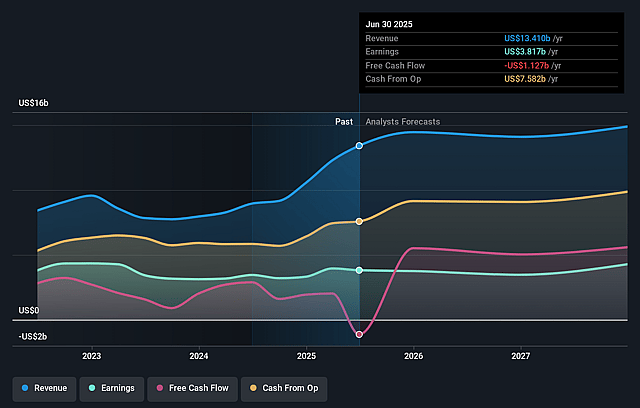
Diamondback Energy Future Earnings and Revenue Growth
Assumptions
How have these above catalysts been quantified?
- This narrative explores a more optimistic perspective on Diamondback Energy compared to the consensus, based on a Fair Value that aligns with the bullish cohort of analysts.
- The bullish analysts are assuming Diamondback Energy's revenue will grow by 6.9% annually over the next 3 years.
- The bullish analysts assume that profit margins will increase from 1.9% today to 45.3% in 3 years time.
- The bullish analysts expect earnings to reach $8.0 billion (and earnings per share of $30.42) by about July 2029, up from $279.0 million today. However, there is some disagreement amongst the analysts with the more bearish ones expecting earnings as low as $4.5 billion.
- In order for the above numbers to justify the price target of the more bullish analyst cohort, the company would need to trade at a PE ratio of 10.8x on those 2029 earnings, down from 188.1x today. This future PE is lower than the current PE for the US Oil and Gas industry at 13.6x.
- The bullish analysts expect the number of shares outstanding to decline by 2.82% per year for the next 3 years.
- To value all of this in today's terms, we will use a discount rate of 7.11%, as per the Simply Wall St company report.
Risks
What could happen that would invalidate this narrative?- The accelerating transition to renewable energy and decarbonization globally poses a significant risk to long-term oil demand, which could diminish Diamondback Energy’s core revenue streams and negatively affect future earnings.
- Increasing regulatory and investor pressure for ESG compliance may raise Diamondback’s operating costs and restrict access to capital markets, impacting both net margins and the company’s ability to fund growth.
- Diamondback’s concentrated operations in the Permian Basin heighten vulnerability to region-specific risks such as local regulatory changes or declines in production, which could destabilize revenue and earnings over time.
- Sustained high capital expenditures are required to maintain and grow production, and should oil prices stagnate or decline, Diamondback may see pressured net margins and declining free cash flow, limiting shareholder returns and growth capital.
- Depletion of current reserves forces Diamondback to either invest heavily in costly new drilling or pursue expensive acquisitions, which may constrain long-term earnings and introduce greater balance sheet risk if production replacement becomes less economically viable.
Valuation
How have all the factors above been brought together to estimate a fair value?
- The assumed bullish price target for Diamondback Energy is $272.0, which represents up to two standard deviations above the consensus price target of $232.07. This valuation is based on what can be assumed as the expectations of Diamondback Energy's future earnings growth, profit margins and other risk factors from analysts on the bullish end of the spectrum.
- However, there is a degree of disagreement amongst analysts, with the most bullish reporting a price target of $272.0, and the most bearish reporting a price target of just $186.0.
- In order for you to agree with the more bullish analyst cohort, you'd need to believe that by 2029, revenues will be $17.7 billion, earnings will come to $8.0 billion, and it would be trading on a PE ratio of 10.8x, assuming you use a discount rate of 7.1%.
- Given the current share price of $186.6, the analyst price target of $272.0 is 31.4% higher.
- We always encourage you to reach your own conclusions though. So sense check these analyst numbers against your own assumptions and expectations based on your understanding of the business and what you believe is probable.
Have other thoughts on Diamondback Energy?
Create your own narrative on this stock, and estimate its Fair Value using our Valuator tool.
Create NarrativeHow well do narratives help inform your perspective?
Disclaimer
AnalystHighTarget is a tool utilizing a Large Language Model (LLM) that ingests data on consensus price targets, forecasted revenue and earnings figures, as well as the transcripts of earnings calls to produce qualitative analysis. The narratives produced by AnalystHighTarget are general in nature and are based solely on analyst data and publicly-available material published by the respective companies. These scenarios are not indicative of the company's future performance and are exploratory in nature. Simply Wall St has no position in the company(s) mentioned. Simply Wall St may provide the securities issuer or related entities with website advertising services for a fee, on an arm's length basis. These relationships have no impact on the way we conduct our business, the content we host, or how our content is served to users. The price targets and estimates used are consensus data, and do not constitute a recommendation to buy or sell any stock, and they do not take account of your objectives, or your financial situation. Note that AnalystHighTarget's analysis may not factor in the latest price-sensitive company announcements or qualitative material.


