
Advertisement
- United States
- /
- IT
- /
- NasdaqGM:BLZE
Backblaze, Inc. (NASDAQ:BLZE) Just Released Its First-Quarter Earnings: Here's What Analysts Think
It's been a pretty great week for Backblaze, Inc. (NASDAQ:BLZE) shareholders, with its shares surging 15% to US$5.22 in the week since its latest first-quarter results. The results look positive overall; while revenues of US$35m were in line with analyst predictions, statutory losses were 8.9% smaller than expected, with Backblaze losing US$0.17 per share. This is an important time for investors, as they can track a company's performance in its report, look at what experts are forecasting for next year, and see if there has been any change to expectations for the business. So we collected the latest post-earnings statutory consensus estimates to see what could be in store for next year.
Our free stock report includes 3 warning signs investors should be aware of before investing in Backblaze. Read for free now.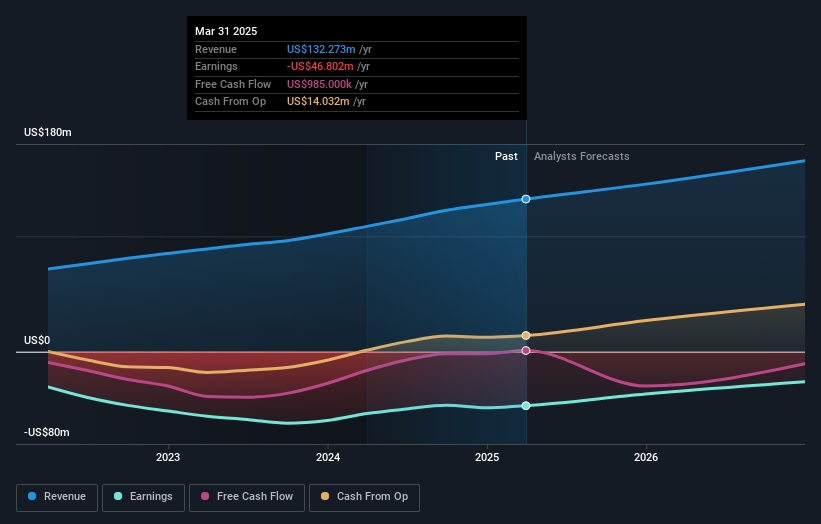
After the latest results, the seven analysts covering Backblaze are now predicting revenues of US$145.2m in 2025. If met, this would reflect a decent 9.8% improvement in revenue compared to the last 12 months. The loss per share is expected to greatly reduce in the near future, narrowing 25% to US$0.64. Before this latest report, the consensus had been expecting revenues of US$144.4m and US$0.63 per share in losses. Overall it looks as though the analysts were a bit mixed on the latest consensus updates. Although revenue forecasts held steady, the consensus also made a modest increase to its losses per share forecasts.
See our latest analysis for Backblaze
The consensus price target held steady at US$12.32, seemingly implying that the higher forecast losses are not expected to have a long term impact on the company's valuation. It could also be instructive to look at the range of analyst estimates, to evaluate how different the outlier opinions are from the mean. There are some variant perceptions on Backblaze, with the most bullish analyst valuing it at US$15.90 and the most bearish at US$10.00 per share. These price targets show that analysts do have some differing views on the business, but the estimates do not vary enough to suggest to us that some are betting on wild success or utter failure.
Taking a look at the bigger picture now, one of the ways we can understand these forecasts is to see how they compare to both past performance and industry growth estimates. It's pretty clear that there is an expectation that Backblaze's revenue growth will slow down substantially, with revenues to the end of 2025 expected to display 13% growth on an annualised basis. This is compared to a historical growth rate of 20% over the past three years. Juxtapose this against the other companies in the industry with analyst coverage, which are forecast to grow their revenues (in aggregate) 9.8% per year. Even after the forecast slowdown in growth, it seems obvious that Backblaze is also expected to grow faster than the wider industry.
The Bottom Line
The most important thing to take away is that the analysts increased their loss per share estimates for next year. Fortunately, they also reconfirmed their revenue numbers, suggesting that it's tracking in line with expectations. Additionally, our data suggests that revenue is expected to grow faster than the wider industry. The consensus price target held steady at US$12.32, with the latest estimates not enough to have an impact on their price targets.
Keeping that in mind, we still think that the longer term trajectory of the business is much more important for investors to consider. We have estimates - from multiple Backblaze analysts - going out to 2026, and you can see them free on our platform here.
However, before you get too enthused, we've discovered 3 warning signs for Backblaze (1 is concerning!) that you should be aware of.
Valuation is complex, but we're here to simplify it.
Discover if Backblaze might be undervalued or overvalued with our detailed analysis, featuring fair value estimates, potential risks, dividends, insider trades, and its financial condition.
Access Free AnalysisHave feedback on this article? Concerned about the content? Get in touch with us directly. Alternatively, email editorial-team (at) simplywallst.com.
This article by Simply Wall St is general in nature. We provide commentary based on historical data and analyst forecasts only using an unbiased methodology and our articles are not intended to be financial advice. It does not constitute a recommendation to buy or sell any stock, and does not take account of your objectives, or your financial situation. We aim to bring you long-term focused analysis driven by fundamental data. Note that our analysis may not factor in the latest price-sensitive company announcements or qualitative material. Simply Wall St has no position in any stocks mentioned.
MI

The Foxhole
Is Nvidia actually expensive at 32 times earnings? I think that number can melt faster than people realise.
1410
MA
marcus_l38oa
Why would I fret over Nvidia results now? I think it's moment has gone. I will invert and see what companies can be the next Nvidia.
SE
sean_3pk06
Multiple has already melted 50 percent in the last year. It can melt another 50 percent from here in the next year?
 Mitchell Lawler
Market Insights
Which payment stocks actually get paid?

Every new payment app was supposed to kill Visa and Mastercard. Instead, they got bigger. So what does that mean for the payment stocks on your radar?
42
About NasdaqGM:BLZE
Backblaze
A cloud storage platform, provides businesses and consumers cloud services to store, use, and protect data in the United States, the United Kingdom, Canada, and internationally.
Excellent balance sheet with slight risk.
Similar Companies
Market Insights


Advertisement
Weekly Picks
RI


Rick_Orford on Starfighters Space ·
The 1960s Fighter Jet That Could Crack Open a $20 Billion Satellite Market
Fair Value:US$522.6% undervalued
71 followersusers have followed this narrative
4 commentsusers have commented on this narrative
11 likesusers have liked this narrative
TR


tripledub on Meta Platforms ·
The $135 Billion Bet That Should Make Every Shareholder Nervous
Fair Value:US$5861.7% undervalued
56 followersusers have followed this narrative
3 commentsusers have commented on this narrative
34 likesusers have liked this narrative
TA


Talos on Voyager Technologies ·
The "Landlord of Orbit" – A Deep Value Play Ahead of the Starlab Era
Fair Value:US$385.291.0% undervalued
49 followersusers have followed this narrative
0 commentsusers have commented on this narrative
5 likesusers have liked this narrative
IV

Ivoed on Uber Technologies ·
Uber’s Valuation Depends On Who Captures The Economics Of Driverless Rides
Fair Value:US$11632.3% undervalued
12 followersusers have followed this narrative
0 commentsusers have commented on this narrative
3 likesusers have liked this narrative
Recently Updated Narratives
JO


John_Eric on Veeva Systems ·
AI-Powered Veeva Systems Poised for Solid Growth Amid Regulatory Stability
Fair Value:US$383.1436.1% undervalued
45 followersusers have followed this narrative
0 commentsusers have commented on this narrative
0 likesusers have liked this narrative
LU


LunaRodas on NVIDIA ·
NVDA | Nvidia Corporation: What They Said vs. What They Did
Fair Value:US$315.0333.4% undervalued
1 followerusers have followed this narrative
0 commentsusers have commented on this narrative
0 likesusers have liked this narrative
IN

InvestingNurse on Lexaria Bioscience ·
Lexaria Bioscience's Breakthrough with DehydraTECH to Revolutionize Drug Delivery
Fair Value:US$2352.0% undervalued
3 followersusers have followed this narrative
0 commentsusers have commented on this narrative
0 likesusers have liked this narrative
Popular Narratives
OS

oscargarcia on NVIDIA ·
The company that went from selling GPUs to gamers to becoming the AI arms dealer of the 21st century.
Fair Value:US$28025.1% undervalued
359 followersusers have followed this narrative
9 commentsusers have commented on this narrative
16 likesusers have liked this narrative
CU

CubanEros on Microsoft ·
A wonderful business at reasonable price.
Fair Value:US$419.9118.2% overvalued
207 followersusers have followed this narrative
0 commentsusers have commented on this narrative
9 likesusers have liked this narrative
KI

KiwiInvest on Amazon.com ·
Amazon's high growth, high tech segments propel its profits, while traditional segments plod along
Fair Value:US$475.0945.2% undervalued
231 followersusers have followed this narrative
1 commentusers have commented on this narrative
8 likesusers have liked this narrative


