
Advertisement
- United States
- /
- Healthtech
- /
- NasdaqCM:OPRX
Is OptimizeRx (NASDAQ:OPRX) Using Too Much Debt?
Some say volatility, rather than debt, is the best way to think about risk as an investor, but Warren Buffett famously said that 'Volatility is far from synonymous with risk.' So it might be obvious that you need to consider debt, when you think about how risky any given stock is, because too much debt can sink a company. We can see that OptimizeRx Corporation (NASDAQ:OPRX) does use debt in its business. But the more important question is: how much risk is that debt creating?
Why Does Debt Bring Risk?
Generally speaking, debt only becomes a real problem when a company can't easily pay it off, either by raising capital or with its own cash flow. Ultimately, if the company can't fulfill its legal obligations to repay debt, shareholders could walk away with nothing. However, a more usual (but still expensive) situation is where a company must dilute shareholders at a cheap share price simply to get debt under control. Of course, the upside of debt is that it often represents cheap capital, especially when it replaces dilution in a company with the ability to reinvest at high rates of return. When we think about a company's use of debt, we first look at cash and debt together.
What Is OptimizeRx's Debt?
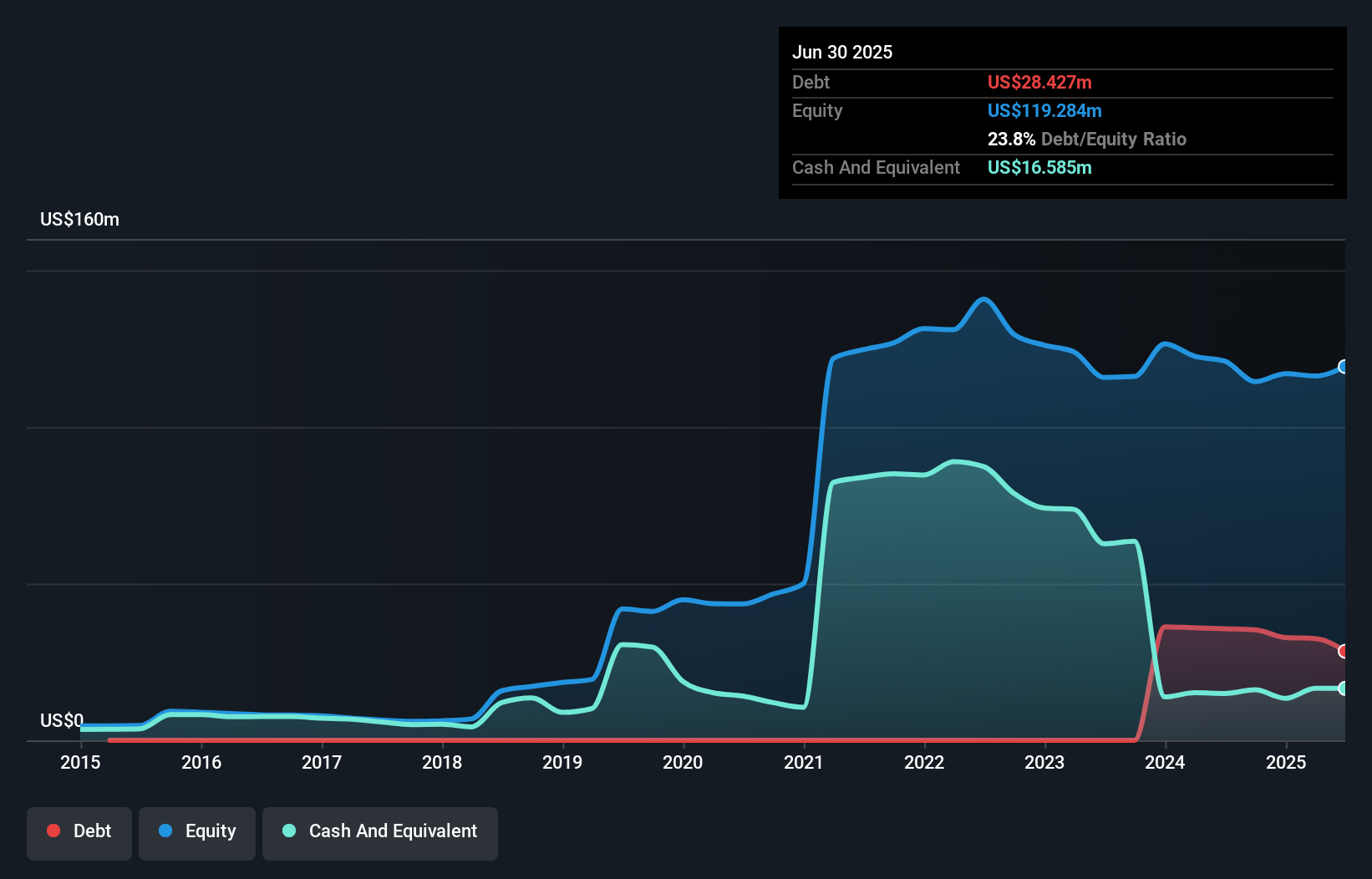
The image below, which you can click on for greater detail, shows that OptimizeRx had debt of US$28.4m at the end of June 2025, a reduction from US$35.6m over a year. However, it also had US$16.6m in cash, and so its net debt is US$11.8m.
How Healthy Is OptimizeRx's Balance Sheet?
According to the last reported balance sheet, OptimizeRx had liabilities of US$21.1m due within 12 months, and liabilities of US$28.9m due beyond 12 months. Offsetting these obligations, it had cash of US$16.6m as well as receivables valued at US$34.2m due within 12 months. So its total liabilities are just about perfectly matched by its shorter-term, liquid assets.
Having regard to OptimizeRx's size, it seems that its liquid assets are well balanced with its total liabilities. So while it's hard to imagine that the US$348.1m company is struggling for cash, we still think it's worth monitoring its balance sheet.
View our latest analysis for OptimizeRx
We measure a company's debt load relative to its earnings power by looking at its net debt divided by its earnings before interest, tax, depreciation, and amortization (EBITDA) and by calculating how easily its earnings before interest and tax (EBIT) cover its interest expense (interest cover). This way, we consider both the absolute quantum of the debt, as well as the interest rates paid on it.
Given net debt is only 1.5 times EBITDA, it is initially surprising to see that OptimizeRx's EBIT has low interest coverage of 0.65 times. So one way or the other, it's clear the debt levels are not trivial. Notably, OptimizeRx made a loss at the EBIT level, last year, but improved that to positive EBIT of US$3.6m in the last twelve months. There's no doubt that we learn most about debt from the balance sheet. But it is future earnings, more than anything, that will determine OptimizeRx's ability to maintain a healthy balance sheet going forward. So if you're focused on the future you can check out this free report showing analyst profit forecasts.
Finally, a business needs free cash flow to pay off debt; accounting profits just don't cut it. So it is important to check how much of its earnings before interest and tax (EBIT) converts to actual free cash flow. Happily for any shareholders, OptimizeRx actually produced more free cash flow than EBIT over the last year. There's nothing better than incoming cash when it comes to staying in your lenders' good graces.
Our View
OptimizeRx's conversion of EBIT to free cash flow suggests it can handle its debt as easily as Cristiano Ronaldo could score a goal against an under 14's goalkeeper. But the stark truth is that we are concerned by its interest cover. It's also worth noting that OptimizeRx is in the Healthcare Services industry, which is often considered to be quite defensive. Taking all this data into account, it seems to us that OptimizeRx takes a pretty sensible approach to debt. That means they are taking on a bit more risk, in the hope of boosting shareholder returns. There's no doubt that we learn most about debt from the balance sheet. However, not all investment risk resides within the balance sheet - far from it. For instance, we've identified 2 warning signs for OptimizeRx that you should be aware of.
If you're interested in investing in businesses that can grow profits without the burden of debt, then check out this free list of growing businesses that have net cash on the balance sheet.
New: AI Stock Screener & Alerts
Our new AI Stock Screener scans the market every day to uncover opportunities.
• Dividend Powerhouses (3%+ Yield)
• Undervalued Small Caps with Insider Buying
• High growth Tech and AI Companies
Or build your own from over 50 metrics.
Have feedback on this article? Concerned about the content? Get in touch with us directly. Alternatively, email editorial-team (at) simplywallst.com.
This article by Simply Wall St is general in nature. We provide commentary based on historical data and analyst forecasts only using an unbiased methodology and our articles are not intended to be financial advice. It does not constitute a recommendation to buy or sell any stock, and does not take account of your objectives, or your financial situation. We aim to bring you long-term focused analysis driven by fundamental data. Note that our analysis may not factor in the latest price-sensitive company announcements or qualitative material. Simply Wall St has no position in any stocks mentioned.
MI

The Foxhole
Google (GOOG) just paid US$10 million for a dead airline's emails. I think some companies are sitting on undervalued data goldmines, just waiting to strike a deal. But which can monetize it without going broke?
1110
PO
PowerLaw
Reddit is re-evaluating it's play here. It is worth watching. The consumers of data can also become competitors. It's a much bigger threat.
JA
jake_vw4g3
It only matters to a business if it can become a recurrent revenue stream. Mostly one off sales don't go anywhere.
About NasdaqCM:OPRX
OptimizeRx
Operates as a digital healthcare technology company.
Good value with adequate balance sheet.
Similar Companies
Market Insights


Advertisement
Weekly Picks
RI


Rick_Orford on Starfighters Space ·
The 1960s Fighter Jet That Could Crack Open a $20 Billion Satellite Market
Fair Value:US$520.6% undervalued
52 followersusers have followed this narrative
2 commentsusers have commented on this narrative
7 likesusers have liked this narrative
JO


John_Eric on MercadoLibre ·
MercadoLibre and the Spreadsheet Trick That Decides Everything
Fair Value:US$7.31k73.9% undervalued
95 followersusers have followed this narrative
2 commentsusers have commented on this narrative
14 likesusers have liked this narrative
RC

rcb9 on PayPal Holdings ·
Ten Percent More Volume, One Percent More Transaction Margin
Fair Value:US$70.8913.6% undervalued
12 followersusers have followed this narrative
1 commentusers have commented on this narrative
5 likesusers have liked this narrative
HE


HedgeY on Micron Technology ·
Micron - The Memory Bottleneck Behind the AI Supercycle
Fair Value:US$1.25k25.0% undervalued
34 followersusers have followed this narrative
0 commentsusers have commented on this narrative
11 likesusers have liked this narrative
Recently Updated Narratives
JO

John_Eric on Betterware de MéxicoP.I. de ·
Only Two Analysts Cover This Stock.
Fair Value:US$59.672.9% undervalued
1 followerusers have followed this narrative
0 commentsusers have commented on this narrative
0 likesusers have liked this narrative
LU


LunaRodas on Jack Henry & Associates ·
JKHY | Jack Henry: What They Said vs. What They Did
Fair Value:US$163.690.4% undervalued
1 followerusers have followed this narrative
0 commentsusers have commented on this narrative
0 likesusers have liked this narrative
DA

david_1211213 on Lotus Technology ·
When History and Modern Collide, The Possibilities Expand for Lotus Technology Inc. (LOT)
Fair Value:US$4.576.9% undervalued
1 followerusers have followed this narrative
3 commentsusers have commented on this narrative
0 likesusers have liked this narrative
Popular Narratives
OS


oscargarcia on NVIDIA ·
The company that went from selling GPUs to gamers to becoming the AI arms dealer of the 21st century.
Fair Value:US$28022.3% undervalued
329 followersusers have followed this narrative
9 commentsusers have commented on this narrative
16 likesusers have liked this narrative
CU

CubanEros on Microsoft ·
A wonderful business at reasonable price.
Fair Value:US$419.9115.3% overvalued
182 followersusers have followed this narrative
0 commentsusers have commented on this narrative
9 likesusers have liked this narrative
KI

KiwiInvest on Amazon.com ·
Amazon's high growth, high tech segments propel its profits, while traditional segments plod along
Fair Value:US$475.0944.0% undervalued
207 followersusers have followed this narrative
1 commentusers have commented on this narrative
8 likesusers have liked this narrative
Trending Discussion
JA
james_rxfd8 on Starfighters Space ·
How is this different to Virgin Orbit, which didn’t seem to work out, with a very similar plan?
4
|2

