
Advertisement
- United States
- /
- Aerospace & Defense
- /
- NYSE:MOG.A
Does Moog Inc. (NYSE:MOG.A) Create Value For Shareholders?
While some investors are already well versed in financial metrics (hat tip), this article is for those who would like to learn about Return On Equity (ROE) and why it is important. We'll use ROE to examine Moog Inc. (NYSE:MOG.A), by way of a worked example.
Our data shows Moog has a return on equity of 14% for the last year. Another way to think of that is that for every $1 worth of equity in the company, it was able to earn $0.14.
Check out our latest analysis for Moog
How Do You Calculate ROE?
The formula for return on equity is:
Return on Equity = Net Profit ÷ Shareholders' Equity
Or for Moog:
14% = US$180m ÷ US$1.3b (Based on the trailing twelve months to September 2019.)
It's easy to understand the 'net profit' part of that equation, but 'shareholders' equity' requires further explanation. It is all earnings retained by the company, plus any capital paid in by shareholders. Shareholders' equity can be calculated by subtracting the total liabilities of the company from the total assets of the company.
What Does Return On Equity Signify?
ROE measures a company's profitability against the profit it retains, and any outside investments. The 'return' is the yearly profit. The higher the ROE, the more profit the company is making. So, all else equal, investors should like a high ROE. That means it can be interesting to compare the ROE of different companies.
Does Moog Have A Good ROE?
One simple way to determine if a company has a good return on equity is to compare it to the average for its industry. The limitation of this approach is that some companies are quite different from others, even within the same industry classification. You can see in the graphic below that Moog has an ROE that is fairly close to the average for the Aerospace & Defense industry (14%).
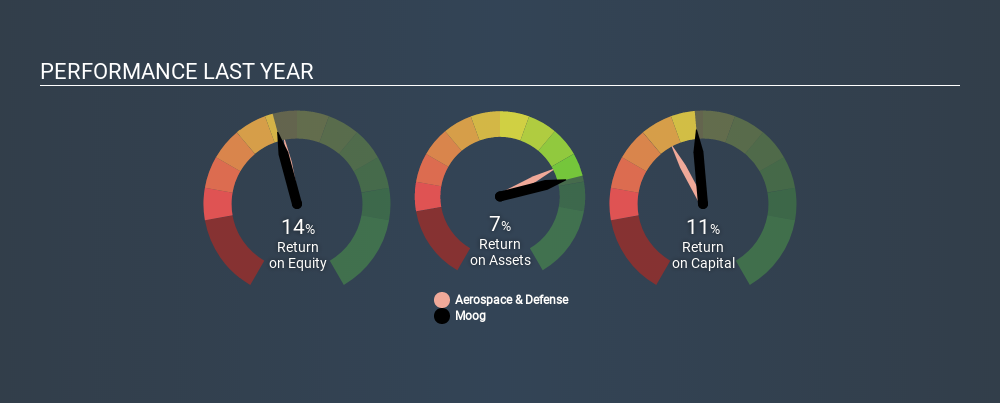
That's not overly surprising. ROE can give us a view about company quality, but many investors also look to other factors, such as whether there are insiders buying shares. I will like Moog better if I see some big insider buys. While we wait, check out this free list of growing companies with considerable, recent, insider buying.
How Does Debt Impact Return On Equity?
Most companies need money -- from somewhere -- to grow their profits. The cash for investment can come from prior year profits (retained earnings), issuing new shares, or borrowing. In the case of the first and second options, the ROE will reflect this use of cash, for growth. In the latter case, the use of debt will improve the returns, but will not change the equity. Thus the use of debt can improve ROE, albeit along with extra risk in the case of stormy weather, metaphorically speaking.
Moog's Debt And Its 14% ROE
Moog has a debt to equity ratio of 0.63, which is far from excessive. Its very respectable ROE, combined with only modest debt, suggests the business is in good shape. Judicious use of debt to improve returns can certainly be a good thing, although it does elevate risk slightly and reduce future optionality.
The Bottom Line On ROE
Return on equity is one way we can compare the business quality of different companies. In my book the highest quality companies have high return on equity, despite low debt. All else being equal, a higher ROE is better.
But when a business is high quality, the market often bids it up to a price that reflects this. Profit growth rates, versus the expectations reflected in the price of the stock, are a particularly important to consider. So I think it may be worth checking this free report on analyst forecasts for the company.
But note: Moog may not be the best stock to buy. So take a peek at this free list of interesting companies with high ROE and low debt.
If you spot an error that warrants correction, please contact the editor at editorial-team@simplywallst.com. This article by Simply Wall St is general in nature. It does not constitute a recommendation to buy or sell any stock, and does not take account of your objectives, or your financial situation. Simply Wall St has no position in the stocks mentioned.
We aim to bring you long-term focused research analysis driven by fundamental data. Note that our analysis may not factor in the latest price-sensitive company announcements or qualitative material. Thank you for reading.
 mitchell_lawler
The Foxhole
The smartphone and the smartwatch were both supposed to unwind the mechanical watch. So why has Seiko (TSE:8050) roughly quadrupled in a year?
1312
darius_xnnrd
Heard of Veblen goods? As the price goes up, demand goes up. Luxury stuff. It might only work only for Veblen stuff
Quantanium
Seiko could have an overlooked AI angle.
Buried inside the watchmaker is the world’s #1 supplier of SPXO crystal oscillator ICs, which are tiny timing chips increasingly needed for high-speed optical communications in AI data centres. It originally established this technology for its quartz watches.
Seiko says AI demand is already driving strong growth in the business.
About NYSE:MOG.A
Moog
Designs, manufactures, and integrates precision motion and fluid controls and controls systems for original equipment manufacturers and end users in the aerospace, defense, and industrial markets in the United States, Germany, and internationally.
Flawless balance sheet with solid track record.
Similar Companies
Market Insights

Advertisement
Weekly Picks
DA


davidlsander on Optimi Health ·
OPTH: A licensed manufacturer already selling MDMA while peers still wait on trials
Fair Value:US$1260.4% undervalued
17 followersusers have followed this narrative
0 commentsusers have commented on this narrative
2 likesusers have liked this narrative
FU

FundamentalFlow on Vertiv Holdings Co ·
The Short and Long Term Compounder of Liquid Cooling industry.
Fair Value:US$45035.9% undervalued
39 followersusers have followed this narrative
0 commentsusers have commented on this narrative
12 likesusers have liked this narrative
JO


John_Eric on SPX Technologies ·
I Fell in Love With a Data-Center Cooling Stock. Then I Opened the Filings.
Fair Value:US$2037.5% overvalued
18 followersusers have followed this narrative
1 commentusers have commented on this narrative
4 likesusers have liked this narrative
TR


tripledub on GQG Partners ·
The Cheap Genius Problem
Fair Value:AU$3.2154.2% undervalued
27 followersusers have followed this narrative
0 commentsusers have commented on this narrative
20 likesusers have liked this narrative
Recently Updated Narratives
VA


Valtersa on Elm ·
Elm poised for a promising 3-year growth with 21.7% future PE surge
Fair Value:ر.س619.942.2% undervalued
1 followerusers have followed this narrative
0 commentsusers have commented on this narrative
0 likesusers have liked this narrative
VA

Valtersa on Almoosa Health ·
Normalized Earnings-Based Relative Valuation with a Discounted Forward Exit Multiple
Fair Value:ر.س15524.1% undervalued
1 followerusers have followed this narrative
0 commentsusers have commented on this narrative
0 likesusers have liked this narrative
BR


Brogers on Pigeon ·
Pigeon Capital: A Sector Note on Avian-Adjacent Alpha
Fair Value:JP¥2.01k3.8% overvalued
1 followerusers have followed this narrative
0 commentsusers have commented on this narrative
0 likesusers have liked this narrative
Popular Narratives
OS


oscargarcia on NVIDIA ·
The company that went from selling GPUs to gamers to becoming the AI arms dealer of the 21st century.
Fair Value:US$28020.0% undervalued
300 followersusers have followed this narrative
9 commentsusers have commented on this narrative
16 likesusers have liked this narrative
CU

CubanEros on Microsoft ·
A wonderful business at reasonable price.
Fair Value:US$419.9117.3% overvalued
161 followersusers have followed this narrative
0 commentsusers have commented on this narrative
8 likesusers have liked this narrative
KI

KiwiInvest on Amazon.com ·
Amazon's high growth, high tech segments propel its profits, while traditional segments plod along
Fair Value:US$475.0943.7% undervalued
181 followersusers have followed this narrative
1 commentusers have commented on this narrative
8 likesusers have liked this narrative
Trending Discussion
GE

george_b177x on Bloom Energy ·
Brilliant analysis. Great company with proven product and service!
1
|0
IA

ian_oii7z on Woodside Energy Group ·
Hey James! Thank you but I am not sure if I am reading this correctly as your analysis opens with "At A$36.602 per share, Woodside Energy Group (ASX: WDS) appears reasonably valued based on its existing operations and near-term production growth." I would like to say that the last time that WDS was above $36.00 per share was in October 2023, so I am a little confused by your statement w.r.t. current prices etc . Can you please explain?
1
|0
ST

stephen_1gfgn on CSL ·
This commentary is confusing CSL in the USA and CSL on the ASX. They are different companies in different industries. The note at the top referring to the Seqirus demerger is about the Australian CSL company and has nothing to do with roofing. This same error was made a few weeks ago.
0
|0