
Advertisement
- United States
- /
- Entertainment
- /
- NasdaqGM:GRVY
Can Gravity Co., Ltd.'s (NASDAQ:GRVY) ROE Continue To Surpass The Industry Average?
Many investors are still learning about the various metrics that can be useful when analysing a stock. This article is for those who would like to learn about Return On Equity (ROE). We'll use ROE to examine Gravity Co., Ltd. (NASDAQ:GRVY), by way of a worked example.
Gravity has a ROE of 34%, based on the last twelve months. Another way to think of that is that for every $1 worth of equity in the company, it was able to earn $0.34.
View our latest analysis for Gravity
How Do I Calculate Return On Equity?
The formula for ROE is:
Return on Equity = Net Profit (from continuing operations) ÷ Shareholders' Equity
Or for Gravity:
34% = ₩40b ÷ ₩116b (Based on the trailing twelve months to December 2019.)
Most know that net profit is the total earnings after all expenses, but the concept of shareholders' equity is a little more complicated. It is all earnings retained by the company, plus any capital paid in by shareholders. Shareholders' equity can be calculated by subtracting the total liabilities of the company from the total assets of the company.
What Does ROE Mean?
Return on Equity measures a company's profitability against the profit it has kept for the business (plus any capital injections). The 'return' is the profit over the last twelve months. The higher the ROE, the more profit the company is making. So, as a general rule, a high ROE is a good thing. Clearly, then, one can use ROE to compare different companies.
Does Gravity Have A Good Return On Equity?
One simple way to determine if a company has a good return on equity is to compare it to the average for its industry. The limitation of this approach is that some companies are quite different from others, even within the same industry classification. Pleasingly, Gravity has a superior ROE than the average (14%) company in the Entertainment industry.
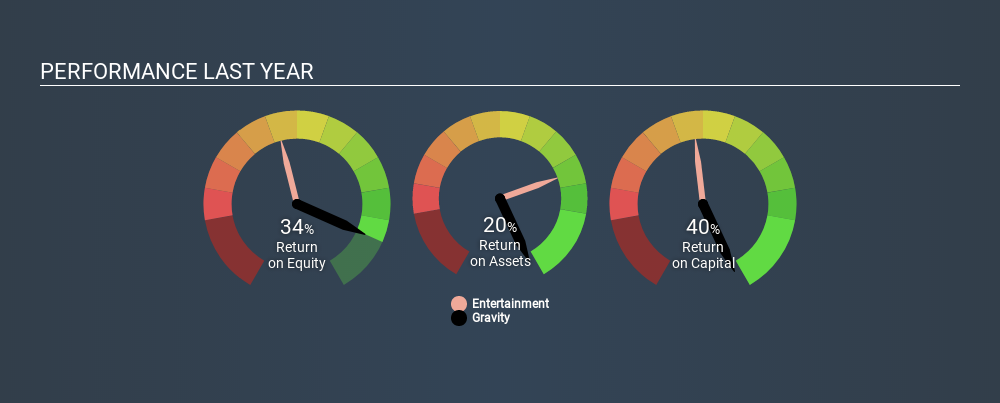
That's clearly a positive. I usually take a closer look when a company has a better ROE than industry peers. One data point to check is if insiders have bought shares recently.
How Does Debt Impact Return On Equity?
Virtually all companies need money to invest in the business, to grow profits. The cash for investment can come from prior year profits (retained earnings), issuing new shares, or borrowing. In the case of the first and second options, the ROE will reflect this use of cash, for growth. In the latter case, the use of debt will improve the returns, but will not change the equity. That will make the ROE look better than if no debt was used.
Gravity's Debt And Its 34% ROE
Shareholders will be pleased to learn that Gravity has not one iota of net debt! Its impressive ROE suggests it is a high quality business, but it's even better to have achieved that without leverage. After all, with cash on the balance sheet, a company has a lot more optionality in good times and bad.
But It's Just One Metric
Return on equity is a useful indicator of the ability of a business to generate profits and return them to shareholders. Companies that can achieve high returns on equity without too much debt are generally of good quality. If two companies have the same ROE, then I would generally prefer the one with less debt.
But ROE is just one piece of a bigger puzzle, since high quality businesses often trade on high multiples of earnings. Profit growth rates, versus the expectations reflected in the price of the stock, are a particularly important to consider. So I think it may be worth checking this free this detailed graph of past earnings, revenue and cash flow.
Of course Gravity may not be the best stock to buy. So you may wish to see this free collection of other companies that have high ROE and low debt.
If you spot an error that warrants correction, please contact the editor at editorial-team@simplywallst.com. This article by Simply Wall St is general in nature. It does not constitute a recommendation to buy or sell any stock, and does not take account of your objectives, or your financial situation. Simply Wall St has no position in the stocks mentioned.
We aim to bring you long-term focused research analysis driven by fundamental data. Note that our analysis may not factor in the latest price-sensitive company announcements or qualitative material. Thank you for reading.
About NasdaqGM:GRVY
Gravity
Develops and publishes online and mobile games worldwide.
Flawless balance sheet and good value.
Similar Companies
Market Insights


Advertisement
Weekly Picks
DA


davidlsander on Optimi Health ·
OPTH: A licensed manufacturer already selling MDMA while peers still wait on trials
Fair Value:US$1261.0% undervalued
15 followersusers have followed this narrative
0 commentsusers have commented on this narrative
2 likesusers have liked this narrative
FU

FundamentalFlow on Vertiv Holdings Co ·
The Short and Long Term Compounder of Liquid Cooling industry.
Fair Value:US$45037.4% undervalued
14 followersusers have followed this narrative
0 commentsusers have commented on this narrative
4 likesusers have liked this narrative
JO


John_Eric on SPX Technologies ·
I Fell in Love With a Data-Center Cooling Stock. Then I Opened the Filings.
Fair Value:US$2036.8% overvalued
7 followersusers have followed this narrative
0 commentsusers have commented on this narrative
3 likesusers have liked this narrative
TR


tripledub on GQG Partners ·
The Cheap Genius Problem
Fair Value:AU$2.4540.0% undervalued
17 followersusers have followed this narrative
0 commentsusers have commented on this narrative
18 likesusers have liked this narrative
Recently Updated Narratives
NE

NeuralAlpha on NVIDIA ·
NVIDIA: The Indispensable Backbone of the AI Revolution
Fair Value:US$25013.0% undervalued
20 followersusers have followed this narrative
4 commentsusers have commented on this narrative
0 likesusers have liked this narrative
CO

CoksiBoy on Cisco Systems ·
AI Workforce Rollout
Fair Value:US$14516.9% undervalued
1 followerusers have followed this narrative
0 commentsusers have commented on this narrative
0 likesusers have liked this narrative
RO


RockeTeller on A2 Gold ·
Nevada Gold Silver Giant: 1.4Moz Gold + 20Moz Silver Potential, Kinross-Backed Nevada Play Exploding?
Fair Value:CA$4.2484.2% undervalued
1 followerusers have followed this narrative
0 commentsusers have commented on this narrative
0 likesusers have liked this narrative
Popular Narratives
OS

oscargarcia on NVIDIA ·
The company that went from selling GPUs to gamers to becoming the AI arms dealer of the 21st century.
Fair Value:US$28022.3% undervalued
297 followersusers have followed this narrative
9 commentsusers have commented on this narrative
16 likesusers have liked this narrative
CU

CubanEros on Microsoft ·
A wonderful business at reasonable price.
Fair Value:US$419.9120.0% overvalued
159 followersusers have followed this narrative
0 commentsusers have commented on this narrative
8 likesusers have liked this narrative
KI

KiwiInvest on Amazon.com ·
Amazon's high growth, high tech segments propel its profits, while traditional segments plod along
Fair Value:US$475.0942.7% undervalued
178 followersusers have followed this narrative
1 commentusers have commented on this narrative
8 likesusers have liked this narrative
Trending Discussion

IA

ian_oii7z on Woodside Energy Group ·
Hey James! Thank you but I am not sure if I am reading this correctly as your analysis opens with "At A$36.602 per share, Woodside Energy Group (ASX: WDS) appears reasonably valued based on its existing operations and near-term production growth." I would like to say that the last time that WDS was above $36.00 per share was in October 2023, so I am a little confused by your statement w.r.t. current prices etc . Can you please explain?
1
|0
M0

m00sekateer on Pony AI ·
Checked it. The arithmetic is fine; the inputs aren't, and the conclusion doesn't follow even if they were.1. Fare. $7 is a US robotaxi price. Pony's record peak day in Shenzhen (22 March 2026) was RMB394 net revenue per Gen-7 vehicle on 25 orders — about US$2.20 per order. You're roughly 3x high.2. Utilisation. 25 orders/day is Pony's all-time single-day high, not an average, and you then run it 365 days with zero downtime for charging, cleaning, maintenance, weather or geofence interruption.Corrected, the best day Pony has ever recorded yields ~US$55/day. On $43k of hardware that's ~26 months of gross revenue, before any operating cost. The reported actuals agree: FY2025 robotaxi services revenue US$16.6m on a fleet just past 1,000 units; Q1 2026 US$8.6m with the fleet above 1,700 — call it US$20–25k per vehicle per year against your $63,875.3. The caveat is the whole argument. You flag "not including operational costs (people costs)" and then set it aside. Remote safety operators, platform commissions, charging, insurance, cleaning, depot and maintenance are what determine whether a robotaxi contributes anything at all.4. Payback isn't profitability. Q1 2026: 16.2% gross margin on US$34.3m revenue, US$63.9m of opex, US$53.5m net loss. Marginal hardware payback says nothing about R&D, mapping, licensing or overhead.5. Falling BOM cuts both ways. Pony targets sub-RMB230k (~US$34k) total vehicle cost for 2027. Great for new units, bad for the residual value of fleets already deployed on a five-year depreciation schedule.What you get right: the cost trajectory is real, and city-wide UE breakeven in Guangzhou (Nov 2025) and Shenzhen (Feb 2026) is a genuine milestone. But that is contribution-margin breakeven per trip — not "cracked the per-unit cost," and not an 8-month payback. Your post predates all of it; the data has since landed, and it's less favourable on revenue per vehicle than the model assumed.
0
|0