
Advertisement
Howard Marks put it nicely when he said that, rather than worrying about share price volatility, 'The possibility of permanent loss is the risk I worry about... and every practical investor I know worries about. When we think about how risky a company is, we always like to look at its use of debt, since debt overload can lead to ruin. We can see that Bayer Aktiengesellschaft (ETR:BAYN) does use debt in its business. But is this debt a concern to shareholders?
What Risk Does Debt Bring?
Debt is a tool to help businesses grow, but if a business is incapable of paying off its lenders, then it exists at their mercy. In the worst case scenario, a company can go bankrupt if it cannot pay its creditors. However, a more usual (but still expensive) situation is where a company must dilute shareholders at a cheap share price simply to get debt under control. Having said that, the most common situation is where a company manages its debt reasonably well - and to its own advantage. When we think about a company's use of debt, we first look at cash and debt together.
View our latest analysis for Bayer
What Is Bayer's Net Debt?
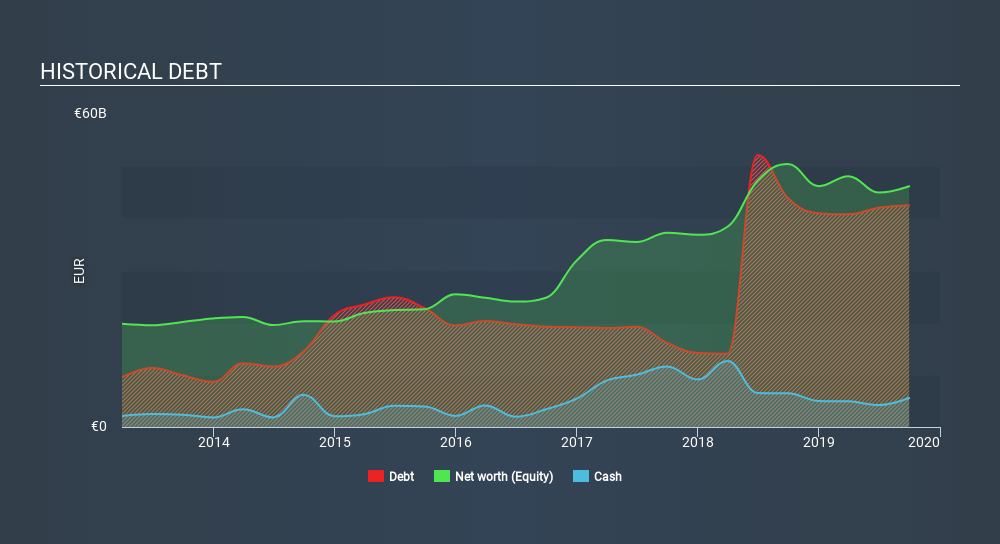
As you can see below, Bayer had €42.5b of debt, at September 2019, which is about the same the year before. You can click the chart for greater detail. However, it does have €5.55b in cash offsetting this, leading to net debt of about €36.9b.
A Look At Bayer's Liabilities
The latest balance sheet data shows that Bayer had liabilities of €26.1b due within a year, and liabilities of €58.6b falling due after that. Offsetting these obligations, it had cash of €5.55b as well as receivables valued at €14.2b due within 12 months. So its liabilities outweigh the sum of its cash and (near-term) receivables by €64.9b.
This deficit is considerable relative to its very significant market capitalization of €69.9b, so it does suggest shareholders should keep an eye on Bayer's use of debt. Should its lenders demand that it shore up the balance sheet, shareholders would likely face severe dilution.
We measure a company's debt load relative to its earnings power by looking at its net debt divided by its earnings before interest, tax, depreciation, and amortization (EBITDA) and by calculating how easily its earnings before interest and tax (EBIT) cover its interest expense (interest cover). The advantage of this approach is that we take into account both the absolute quantum of debt (with net debt to EBITDA) and the actual interest expenses associated with that debt (with its interest cover ratio).
Weak interest cover of 0.36 times and a disturbingly high net debt to EBITDA ratio of 7.7 hit our confidence in Bayer like a one-two punch to the gut. The debt burden here is substantial. Worse, Bayer's EBIT was down 94% over the last year. If earnings keep going like that over the long term, it has a snowball's chance in hell of paying off that debt. There's no doubt that we learn most about debt from the balance sheet. But it is future earnings, more than anything, that will determine Bayer's ability to maintain a healthy balance sheet going forward. So if you want to see what the professionals think, you might find this free report on analyst profit forecasts to be interesting.
Finally, while the tax-man may adore accounting profits, lenders only accept cold hard cash. So the logical step is to look at the proportion of that EBIT that is matched by actual free cash flow. Over the last three years, Bayer actually produced more free cash flow than EBIT. That sort of strong cash conversion gets us as excited as the crowd when the beat drops at a Daft Punk concert.
Our View
On the face of it, Bayer's interest cover left us tentative about the stock, and its EBIT growth rate was no more enticing than the one empty restaurant on the busiest night of the year. But on the bright side, its conversion of EBIT to free cash flow is a good sign, and makes us more optimistic. Overall, we think it's fair to say that Bayer has enough debt that there are some real risks around the balance sheet. If all goes well, that should boost returns, but on the flip side, the risk of permanent capital loss is elevated by the debt. When analysing debt levels, the balance sheet is the obvious place to start. But ultimately, every company can contain risks that exist outside of the balance sheet. For example, we've discovered 3 warning signs for Bayer (1 is a bit unpleasant!) that you should be aware of before investing here.
At the end of the day, it's often better to focus on companies that are free from net debt. You can access our special list of such companies (all with a track record of profit growth). It's free.
If you spot an error that warrants correction, please contact the editor at editorial-team@simplywallst.com. This article by Simply Wall St is general in nature. It does not constitute a recommendation to buy or sell any stock, and does not take account of your objectives, or your financial situation. Simply Wall St has no position in the stocks mentioned.
We aim to bring you long-term focused research analysis driven by fundamental data. Note that our analysis may not factor in the latest price-sensitive company announcements or qualitative material. Thank you for reading.
 mitchell_lawler
The Foxhole
People are still arguing about whether Nvidia's chips are the fastest. What if Jensen just built a moat that has nothing to do with the chips?
1214
PowerLaw
I wonder why Jensen is doing this. It just increases the risks of failure multifold.
zoe_vi5fn
The bearishness in threads like this is itself worth examining. Every large financing innovation has been called a bubble structure at inception, including securitisation of aircraft, of shipping, of fibre and of mortgages, and three of those four turned out to be genuinely useful market infrastructure that lowered the cost of capital for real assets. The failure case gets remembered because it was spectacular.
About XTRA:BAYN
Bayer
Operates as a life science company in Europe, the Middle East, Africa, Germany, Switzerland, North America, the United States, the Asia Pacific, China, Latin America, and Brazil.
Undervalued with adequate balance sheet.
Similar Companies
Market Insights

Advertisement
Weekly Picks
RI


Rick_Orford on Starfighters Space ·
The 1960s Fighter Jet That Could Crack Open a $20 Billion Satellite Market
Fair Value:US$519.8% undervalued
22 followersusers have followed this narrative
1 commentusers have commented on this narrative
3 likesusers have liked this narrative
FU


FundamentalFlow on Vertiv Holdings Co ·
The Short and Long Term Compounder of Liquid Cooling industry.
Fair Value:US$45036.2% undervalued
47 followersusers have followed this narrative
0 commentsusers have commented on this narrative
13 likesusers have liked this narrative
JO


John_Eric on SPX Technologies ·
I Fell in Love With a Data-Center Cooling Stock. Then I Opened the Filings.
Fair Value:US$2034.5% overvalued
20 followersusers have followed this narrative
2 commentsusers have commented on this narrative
4 likesusers have liked this narrative
TR


tripledub on GQG Partners ·
The Cheap Genius Problem
Fair Value:AU$3.2155.5% undervalued
30 followersusers have followed this narrative
0 commentsusers have commented on this narrative
21 likesusers have liked this narrative
Recently Updated Narratives
ST


StoxEurope on Sipef ·
Why I Invest in SIPEF?
Fair Value:€116.2914.9% undervalued
16 followersusers have followed this narrative
4 commentsusers have commented on this narrative
0 likesusers have liked this narrative
RO


RockeTeller on Discovery Mining ·
#1 Silver Play with Positive Cashflow Gold Miner (Top Notch Team)
Fair Value:CA$7084.1% undervalued
61 followersusers have followed this narrative
16 commentsusers have commented on this narrative
0 likesusers have liked this narrative
ZO

zonedinout on Nasdaq ·
Nasdaq revenue will grow by 7.17% while profit margin surges to 35%
Fair Value:US$104.196.3% undervalued
1 followerusers have followed this narrative
0 commentsusers have commented on this narrative
0 likesusers have liked this narrative
Popular Narratives
OS


oscargarcia on NVIDIA ·
The company that went from selling GPUs to gamers to becoming the AI arms dealer of the 21st century.
Fair Value:US$28019.5% undervalued
308 followersusers have followed this narrative
9 commentsusers have commented on this narrative
16 likesusers have liked this narrative
CU

CubanEros on Microsoft ·
A wonderful business at reasonable price.
Fair Value:US$419.9118.3% overvalued
166 followersusers have followed this narrative
0 commentsusers have commented on this narrative
8 likesusers have liked this narrative
KI

KiwiInvest on Amazon.com ·
Amazon's high growth, high tech segments propel its profits, while traditional segments plod along
Fair Value:US$475.0944.2% undervalued
185 followersusers have followed this narrative
1 commentusers have commented on this narrative
8 likesusers have liked this narrative
Trending Discussion
GE

george_b177x on Bloom Energy ·
Brilliant analysis. Great company with proven product and service!
1
|1
IA

ian_oii7z on Woodside Energy Group ·
Hey James! Thank you but I am not sure if I am reading this correctly as your analysis opens with "At A$36.602 per share, Woodside Energy Group (ASX: WDS) appears reasonably valued based on its existing operations and near-term production growth." I would like to say that the last time that WDS was above $36.00 per share was in October 2023, so I am a little confused by your statement w.r.t. current prices etc . Can you please explain?
1
|0