

Last Update 23 Jul 26
Fair value Decreased 15%VICR: AI Licensing And Backlog Strength Will Drive Future Upside
The analyst price target for Vicor has been reset from $375 to $320 as analysts factor in updated fair value, slightly lower revenue growth assumptions of 37.29% versus 41.62%, a modestly higher profit margin outlook of 32.63% versus 32.33%, and a lower future P/E of 50.86 versus 58.58 following recent shareholder meeting insights.
Analyst Commentary
Recent research on Vicor reflects a mix of optimism about long-term potential and a more restrained view when it comes to valuation, execution risks, and the timing of growth tied to its financial targets and AI related opportunities.
Across recent shareholder meeting updates, analysts have highlighted factors such as higher long term financial objectives, licensing activity, and potential AI related growth drivers, while also signaling that these goals depend on Vicor delivering on ambitious revenue and margin targets and successfully converting its pipeline into realized business over several years.
Bearish Takeaways
- Bearish analysts caution that even with the reset price target, Vicor trades on a P/E multiple that already reflects strong growth and high margins, which may leave limited room for error if execution or demand trends fall short of current expectations.
- Some bearish analysts point to the timing risk around long dated opportunities such as potential second generation design wins that may not contribute meaningfully until late 2027, which could create periods where Vicor financial results do not fully align with elevated expectations.
- Bearish analysts emphasize that Vicor long term revenue and margin objectives, including targets like US$2.5b of revenue and a 70% gross margin, require sustained operational discipline and successful scaling, and any delays or cost pressures could challenge the current valuation framework.
- There is also concern among bearish analysts that enthusiasm around AI related growth drivers and licensing momentum could lead to overpaying for the stock if actual contract wins, product ramps, or customer adoption patterns progress more slowly than the market currently anticipates.
What’s in the News for Vicor
- Vicor stock has surged very sharply year to date, with one recent story citing a 137.8% move, as demand tied to AI infrastructure and high density power solutions feeds into product revenue and royalty growth. [Source: Vicor Corporation Surges on AI Driven Demand Amid Capacity Expansion and Strong Backlog]
- The company reported strong Q2 2026 results, with adjusted earnings of US$1.04 per share versus expectations of US$0.65 and revenue of US$143.4 million. The backlog was reported at US$380 million, described as a 145% year over year increase. Management also discussed plans for a second fabrication facility. [Source: Vicor Corporation Reports Strong Q2 2026 Earnings with Surging Backlog and Revenue Growth]
- Vicor raised Q2 2026 revenue guidance from US$126 million to US$142 million, citing rising product revenues and royalties from an additional licensee of its patented power system technology. [Source: Corporate guidance update]
- Recent index reconstitutions shifted Vicor into larger cap and growth oriented benchmarks, including additions to the Russell 1000, Russell Midcap, Russell Midcap Growth Benchmark, Russell 1000 Growth Benchmark, and Russell 1000 Dynamic Index, alongside removals from several Russell 2000 based indices. [Source: Index constituent changes]
- Chairman and CEO Patrizio Vinciarelli executed multiple Rule 10b5 1 stock sales in late June and early July 2026, selling tens of thousands of shares at prices generally between about US$303 and US$382 per share, while retaining over 8.3 million shares directly plus additional indirect holdings. [Source: Vicor CEO Patrizio Vinciarelli Executes Multiple 10b5 1 Stock Sales Amid Strong Revenue Growth]
Valuation Changes for Vicor
- Fair Value: reset from $375.0 to $320.0, indicating a meaningful reduction in the assessed fair value level.
- Discount Rate: adjusted slightly from 9.2002% to 9.0969%, reflecting a modestly lower required return in the updated model.
- Revenue Growth: revised from 41.62% to 37.29%, signaling more conservative assumptions for Vicor top line expansion.
- Net Profit Margin: updated from 32.33% to 32.63%, implying a slightly higher long term profitability outlook.
- Future P/E: moved from 58.58x to 50.86x, pointing to a lower valuation multiple being applied to Vicor expected earnings.
Catalysts
About Vicor
Vicor designs and manufactures high performance power conversion modules and licenses related power system intellectual property.
What are the underlying business or industry changes driving this perspective?
- AI data centers and AI factories are moving toward racks that require hundreds of kilowatts and processors that need thousands of amperes. Vicor is currently tied to a single lead customer for its second generation vertical power delivery solution, so any delay in broader adoption could leave product revenue lagging the scale of AI hardware spending and hold back earnings growth.
- Management describes its IP licensing business as high margin and high growth with a Q3 licensing revenue run rate near US$90 million per year and ambitions to double this over a couple of years. However, the dependence on a limited number of large hyperscalers and OEMs, lumpy deal timing and the finite pool of targets mean that royalty income could plateau sooner than implied and cap future net margin expansion.
- The Andover ChiP fab is described as a US$1b facility with world class yields and very short cycle times. At the same time, management highlights low utilization and under absorption that currently suppress product margins, and if AI power architectures shift more slowly or competitors secure key sockets, Vicor could be locked into structurally lower gross margin on a large fixed cost base, which would pressure operating income.
- Vicor is positioning its fifth generation current multiplier and second generation vertical power delivery as the only way many hyperscalers and OEMs can meet upcoming current density targets above 3 amperes per square millimeter. Any successful alternative approach from VR or IVR suppliers, or an architectural shift in GPUs and TPUs that relaxes those current requirements, could quickly compress Vicor's pricing power and limit revenue growth in its core advanced products.
- The company relies heavily on asserting and enforcing a broad patent portfolio in areas such as bus conversion and power delivery to secure both licensing fees and module pull through. An adverse legal outcome, slower enforcement of exclusion orders or customers choosing to redesign around key patents would weaken licensing leverage, reduce the projected expansion of high margin IP revenue and, in turn, dampen earnings.
Assumptions
How have these above catalysts been quantified?
- This narrative explores a more pessimistic perspective on Vicor compared to the consensus, based on a Fair Value that aligns with the bearish cohort of analysts.
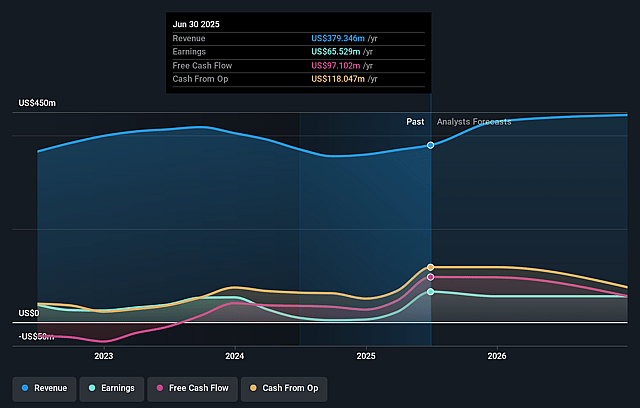
- The bearish analysts are assuming Vicor's revenue will grow by 37.3% annually over the next 3 years.
- The bearish analysts assume that profit margins will increase from 30.6% today to 32.6% in 3 years time.
- The bearish analysts expect earnings to reach $400.3 million (and earnings per share of $8.97) by about July 2029, up from $145.3 million today. However, there is some disagreement amongst the analysts with the more bullish ones expecting earnings as high as $463.3 million.
- In order for the above numbers to justify the price target of the more bearish analyst cohort, the company would need to trade at a PE ratio of 51.0x on those 2029 earnings, down from 68.2x today. This future PE is greater than the current PE for the US Electrical industry at 37.6x.
- The bearish analysts expect the number of shares outstanding to grow by 2.26% per year for the next 3 years.
- To value all of this in today's terms, we will use a discount rate of 9.1%, as per the Simply Wall St company report.
Risks
What could happen that would invalidate this narrative?
- The company reports a consolidated Q3 2025 gross margin of 57.5% and comments that product margins are currently suppressed by low fab utilization. If capacity does start to fill as management expects, higher absorption could support stronger gross margin and earnings rather than a decline in profitability.
- Vicor highlights a licensing revenue run rate near US$90 million per year in Q3 2025 and management talks about line of sight to materially higher returns from IP and litigation. If the IP licensing business continues to expand with more OEM and hyperscaler deals, the high margin nature of this income could support revenue growth and net margin resilience.
- Management reports that the Andover ChiP fab now has world class yields, very short cycle times and strong operational metrics for inventory control, quality and on time delivery. If demand for advanced products and vertical power delivery ramps as outlined, scale through this fab could support higher product revenue and operating leverage.
- The company indicates that second generation vertical power delivery and fifth generation current multipliers are being adopted by a lead AI customer for Q1 2026 production and are now in active engagement with additional hyperscalers and OEMs who see the solution as uniquely able to meet their specifications. Broader design wins could support long term growth in advanced product revenue and earnings.
- Vicor describes a very large and growing long term need for higher current density and more efficient power delivery in AI data centers and AI factories, and management positions the company as one of the few suppliers able to address current density targets above 3 amperes per square millimeter. If AI hardware requirements keep moving in this direction, the underlying secular trend could support sustained demand, pricing power and net margin strength.
Valuation
How have all the factors above been brought together to estimate a fair value?
- The assumed bearish price target for Vicor is $320.0, which represents up to two standard deviations below the consensus price target of $386.25. This valuation is based on what can be assumed as the expectations of Vicor's future earnings growth, profit margins and other risk factors from analysts on the more bearish end of the spectrum.
- However, there is a degree of disagreement amongst analysts, with the most bullish reporting a price target of $450.0, and the most bearish reporting a price target of just $320.0.
- In order for you to agree with the more bearish analyst cohort, you'd need to believe that by 2029, revenues will be $1.2 billion, earnings will come to $400.3 million, and it would be trading on a PE ratio of 51.0x, assuming you use a discount rate of 9.1%.
- Given the current share price of $217.35, the analyst price target of $320.0 is 32.1% higher.
- We always encourage you to reach your own conclusions though. So sense check these analyst numbers against your own assumptions and expectations based on your understanding of the business and what you believe is probable.
Have other thoughts on Vicor?
Create your own narrative on this stock, and estimate its Fair Value using our Valuator tool.
Create NarrativeHow well do narratives help inform your perspective?
Disclaimer
AnalystLowTarget is a tool utilizing a Large Language Model (LLM) that ingests data on consensus price targets, forecasted revenue and earnings figures, as well as the transcripts of earnings calls to produce qualitative analysis. The narratives produced by AnalystLowTarget are general in nature and are based solely on analyst data and publicly-available material published by the respective companies. These scenarios are not indicative of the company's future performance and are exploratory in nature. Simply Wall St has no position in the company(s) mentioned. Simply Wall St may provide the securities issuer or related entities with website advertising services for a fee, on an arm's length basis. These relationships have no impact on the way we conduct our business, the content we host, or how our content is served to users. The price targets and estimates used are consensus data, and do not constitute a recommendation to buy or sell any stock, and they do not take account of your objectives, or your financial situation. Note that AnalystLowTarget's analysis may not factor in the latest price-sensitive company announcements or qualitative material.


