

Last Update 07 Jun 26
Fair value Increased 1.62%SHEL: Future Returns Will Reflect ARC Deal And Middle East Risk
Shell's analyst price target edges higher to about £39 from about £38, as analysts factor the ARC Resources acquisition, revised commodity assumptions, and updated earnings and cash flow estimates into their models.
Analyst Commentary
Recent research points to a mixed but generally constructive reassessment of Shell, with several firms adjusting price targets and ratings as they update models for the ARC Resources acquisition and revised commodity assumptions.
Bullish Takeaways
- Bullish analysts are lifting price targets in both US dollar and sterling terms after factoring in the ARC Resources deal, with some explicitly tying higher targets to refined earnings and cash flow estimates.
- Forecasts for Shell's integrated gas earnings are being recalibrated, with at least one firm building in higher net income across FY26 to FY28 after consolidation of ARC, which feeds through to higher valuation assumptions.
- Some research cites higher cash flow projections and improved medium term visibility in upstream volumes after the ARC transaction, which they see as supporting Shell's ability to sustain distributions.
- Several banks, including large global houses such as JPMorgan and Citi, have moved Shell's sterling price targets higher in recent months, reflecting updated commodity decks and revised capital return frameworks in their models.
Bearish Takeaways
- Bearish analysts have trimmed price targets in euro and sterling terms, signalling concerns that current valuations already discount a sizable portion of the commodity uplift and ARC integration benefits.
- There have been downgrades from some firms that now see more balanced risk and reward, pointing to sector wide rating changes and relative positioning across European energy stocks.
- Several research notes flag macro and geopolitical risks around oil and gas price assumptions, with some houses adjusting long term commodity forecasts and cautioning that Shell's share price is sensitive to these inputs.
- A few downgrades highlight relative valuation gaps versus peers, arguing that Shell's premium or discount to comparable integrated oil companies may be harder to justify if execution on growth projects and integration milestones is slower than expected.
What’s in the News
- Shell agreed to acquire Canadian producer ARC Resources in a transaction valued at about US$22b, with analysts such as HSBC, Jefferies and JP Morgan citing impacts on production, reserves, cash flow forecasts and reduced reliance on large scale future M&A. [Primary sources]
- Q1 2026 results showed adjusted earnings of US$6.9b, a 5% interim dividend of US$0.3906 per share, and the launch of a new US$3b on market share buyback, alongside updated production guidance for Integrated Gas and Upstream. [Primary sources, Key Developments]
- Shell is executing an extensive share buyback programme, having repurchased 270,170,077 shares for about US$10.1b through March 31, 2026, and continuing with additional tranches across multiple exchanges. [Primary sources, Key Developments]
- Portfolio reshaping is in focus, with Shell reviewing options for its renewable platform Sprng Energy, exploring a sale of its South African fuel retail network, and engaging in early interest for its European onshore renewable assets. [Primary sources, Key Developments]
- Operational and ESG developments include force majeure on certain LNG contracts following production issues in Qatar and MiQ Grade A methane emissions certification for Shell’s Gulf of America portfolio, plus reported US$400m in annual savings from AI driven biorefinery maintenance. [Primary sources, Key Developments]
Valuation Changes
- Fair Value: £38.17 to £38.79, a small upward adjustment in the modelled equity value per share.
- Discount Rate: unchanged at 7.38%, indicating no revision to the assumed required return.
- Revenue Growth: 4.15% to 4.42%, a modest increase in the projected top line growth rate.
- Net Profit Margin: 8.39% to 8.20%, a slight reduction in expected profitability on each dollar of revenue.
- Future P/E: 12.25x to 12.56x, a minor uplift in the multiple applied to forward earnings estimates.
Key Takeaways
- Shell's focus on LNG expansion, operational efficiency, and high-grading its portfolio positions it for resilient revenue growth and stronger returns.
- Strong shareholder rewards and strategic flexibility help ensure stability and investor appeal despite market volatility and global energy shifts.
- Continued weakness in chemicals, slow energy transition, and LNG market risks may undermine long-term profitability, while high shareholder payouts threaten future financial flexibility.
Catalysts
About Shell- Operates as an energy and petrochemical company Europe, Asia, Oceania, Africa, the United States, and other Americas.
- Shell's significant and growing investment in LNG, highlighted by the start-up and ramp-up of LNG Canada and new projects in Egypt and Trinidad & Tobago, positions the company to benefit from steadily rising global energy demand and LNG's role as a transition fuel. This is likely to drive long-term top-line revenue growth and support future earnings as Shell's LNG portfolio expands and gains more trading flexibility in key markets.
- Sustained operational efficiencies-demonstrated by nearly $4 billion in structural cost reductions since 2022, targeted at process transformation rather than portfolio trimming-should continue to drive margin expansion and improve net earnings, especially as further simplification and AI/digitalization are rolled out organization-wide.
- Shell's aggressive high-grading of its portfolio (divestment of non-core assets in Chemicals, Retail, and Renewables, and targeted upstream investments in deepwater and LNG) is redirecting capital to higher-return assets and geographies, underpinning higher operating leverage and future ROIC, and paving the way for more robust and resilient free cash flow.
- The company's strong shareholder returns policy-reflected in ongoing multi-billion-dollar buyback programs and a commitment to distributing 40–50% of cash flow from operations-combined with a solid balance sheet, is set to underpin EPS growth and maintain investor appeal, even in the face of cyclical price downturns.
- Shell is structurally positioned to benefit from long-term underinvestment in global oil and gas supply, which could result in tighter commodity markets and higher pricing, supporting profitability in the upstream segment and cushioning revenue as energy security becomes a renewed priority in Europe and Asia amid ongoing geopolitical risks.
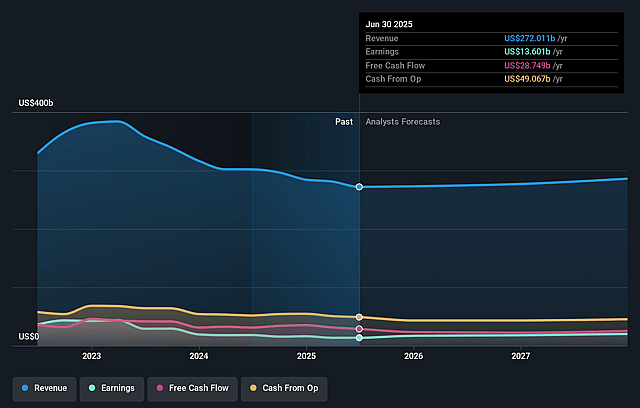
Shell Future Earnings and Revenue Growth
Assumptions
How have these above catalysts been quantified?
- Analysts are assuming Shell's revenue will grow by 4.4% annually over the next 3 years.
- Analysts assume that profit margins will increase from 7.0% today to 8.2% in 3 years time.
- Analysts expect earnings to reach $24.9 billion (and earnings per share of $4.99) by about June 2029, up from $18.8 billion today. However, there is a considerable amount of disagreement amongst the analysts with the most bullish expecting $31.2 billion in earnings, and the most bearish expecting $21.5 billion.
- In order for the above numbers to justify the price target of the analysts, the company would need to trade at a PE ratio of 12.6x on those 2029 earnings, down from 12.8x today. This future PE is lower than the current PE for the GB Oil and Gas industry at 15.2x.
- Analysts expect the number of shares outstanding to decline by 4.63% per year for the next 3 years.
- To value all of this in today's terms, we will use a discount rate of 7.38%, as per the Simply Wall St company report.
Risks
What could happen that would invalidate this narrative?- Prolonged weak margins and sustained overcapacity in the Chemicals business, exacerbated by heavy supply from China and other regions, have resulted in negative free cash flow and required urgent cost and portfolio interventions, indicating a potential drag on segment profitability and group net margins over the long term.
- The company's continued reliance on oil and gas, with limited near-term detail on successful large-scale low-carbon or renewable energy transitions, exposes Shell to accelerating global decarbonization policies and shifts in energy demand, presenting long-term risks to revenue growth and asset value.
- Contract expiries and the loss of previously advantaged LNG supply contracts, paired with expectations for a more oversupplied LNG market, may limit price and margin upside, putting medium
- to long-term pressure on Integrated Gas revenues and net profit.
- Persistent underperformance or potential asset write-downs in loss-making assets such as Shell Polymers Monaca, divested (but not yet stabilized) sites, and non-core capital employed could result in lower returns on capital, further impacting group earnings and shareholder value.
- Heavy shareholder distributions via buybacks (~46% of cash flow from operations) sustained through balance sheet strength, may become less tenable if macro conditions worsen (e.g., falling oil prices, rising interest/lease costs), compromising funding flexibility and putting long-term dividend and buyback growth at risk.
Valuation
How have all the factors above been brought together to estimate a fair value?
- The analysts have a consensus price target of £38.79 for Shell based on their expectations of its future earnings growth, profit margins and other risk factors.
- However, there is a degree of disagreement amongst analysts, with the most bullish reporting a price target of £45.58, and the most bearish reporting a price target of just £35.37.
- In order for you to agree with the analysts, you'd need to believe that by 2029, revenues will be $304.3 billion, earnings will come to $24.9 billion, and it would be trading on a PE ratio of 12.6x, assuming you use a discount rate of 7.4%.
- Given the current share price of £32.27, the analyst price target of £38.79 is 16.8% higher.
- We always encourage you to reach your own conclusions though. So sense check these analyst numbers against your own assumptions and expectations based on your understanding of the business and what you believe is probable.
Have other thoughts on Shell?
Create your own narrative on this stock, and estimate its Fair Value using our Valuator tool.
Create NarrativeHow well do narratives help inform your perspective?
Disclaimer
AnalystConsensusTarget is a tool utilizing a Large Language Model (LLM) that ingests data on consensus price targets, forecasted revenue and earnings figures, as well as the transcripts of earnings calls to produce qualitative analysis. The narratives produced by AnalystConsensusTarget are general in nature and are based solely on analyst data and publicly-available material published by the respective companies. These scenarios are not indicative of the company's future performance and are exploratory in nature. Simply Wall St has no position in the company(s) mentioned. Simply Wall St may provide the securities issuer or related entities with website advertising services for a fee, on an arm's length basis. These relationships have no impact on the way we conduct our business, the content we host, or how our content is served to users. The price targets and estimates used are consensus data, and do not constitute a recommendation to buy or sell any stock, and they do not take account of your objectives, or your financial situation. Note that AnalystConsensusTarget's analysis may not factor in the latest price-sensitive company announcements or qualitative material.


