
Advertisement
- China
- /
- Electronic Equipment and Components
- /
- SZSE:002463
Wus Printed Circuit (Kunshan)'s (SZSE:002463) Earnings Are Of Questionable Quality
Last week's profit announcement from Wus Printed Circuit (Kunshan) Co., Ltd. (SZSE:002463) was underwhelming for investors, despite headline numbers being robust. We think that the market might be paying attention to some underlying factors that they find to be concerning.
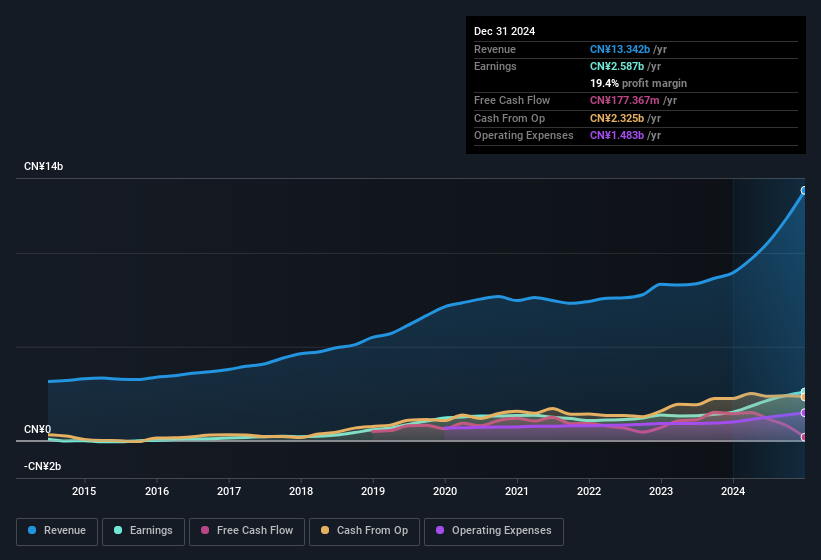
Examining Cashflow Against Wus Printed Circuit (Kunshan)'s Earnings
Many investors haven't heard of the accrual ratio from cashflow, but it is actually a useful measure of how well a company's profit is backed up by free cash flow (FCF) during a given period. To get the accrual ratio we first subtract FCF from profit for a period, and then divide that number by the average operating assets for the period. This ratio tells us how much of a company's profit is not backed by free cashflow.
Therefore, it's actually considered a good thing when a company has a negative accrual ratio, but a bad thing if its accrual ratio is positive. While it's not a problem to have a positive accrual ratio, indicating a certain level of non-cash profits, a high accrual ratio is arguably a bad thing, because it indicates paper profits are not matched by cash flow. That's because some academic studies have suggested that high accruals ratios tend to lead to lower profit or less profit growth.
For the year to December 2024, Wus Printed Circuit (Kunshan) had an accrual ratio of 0.22. We can therefore deduce that its free cash flow fell well short of covering its statutory profit. In fact, it had free cash flow of CN¥177m in the last year, which was a lot less than its statutory profit of CN¥2.59b. Wus Printed Circuit (Kunshan)'s free cash flow actually declined over the last year, but it may bounce back next year, since free cash flow is often more volatile than accounting profits.
That might leave you wondering what analysts are forecasting in terms of future profitability. Luckily, you can click here to see an interactive graph depicting future profitability, based on their estimates.
Our Take On Wus Printed Circuit (Kunshan)'s Profit Performance
Wus Printed Circuit (Kunshan)'s accrual ratio for the last twelve months signifies cash conversion is less than ideal, which is a negative when it comes to our view of its earnings. Because of this, we think that it may be that Wus Printed Circuit (Kunshan)'s statutory profits are better than its underlying earnings power. But the good news is that its EPS growth over the last three years has been very impressive. At the end of the day, it's essential to consider more than just the factors above, if you want to understand the company properly. If you'd like to know more about Wus Printed Circuit (Kunshan) as a business, it's important to be aware of any risks it's facing. To help with this, we've discovered 2 warning signs (1 is significant!) that you ought to be aware of before buying any shares in Wus Printed Circuit (Kunshan).
This note has only looked at a single factor that sheds light on the nature of Wus Printed Circuit (Kunshan)'s profit. But there is always more to discover if you are capable of focussing your mind on minutiae. Some people consider a high return on equity to be a good sign of a quality business. While it might take a little research on your behalf, you may find this free collection of companies boasting high return on equity, or this list of stocks with significant insider holdings to be useful.
Valuation is complex, but we're here to simplify it.
Discover if Wus Printed Circuit (Kunshan) might be undervalued or overvalued with our detailed analysis, featuring fair value estimates, potential risks, dividends, insider trades, and its financial condition.
Access Free AnalysisHave feedback on this article? Concerned about the content? Get in touch with us directly. Alternatively, email editorial-team (at) simplywallst.com.
This article by Simply Wall St is general in nature. We provide commentary based on historical data and analyst forecasts only using an unbiased methodology and our articles are not intended to be financial advice. It does not constitute a recommendation to buy or sell any stock, and does not take account of your objectives, or your financial situation. We aim to bring you long-term focused analysis driven by fundamental data. Note that our analysis may not factor in the latest price-sensitive company announcements or qualitative material. Simply Wall St has no position in any stocks mentioned.
About SZSE:002463
Wus Printed Circuit (Kunshan)
Engages in the sales of printed circuit board in China.
High growth potential with excellent balance sheet.
Market Insights

Advertisement
Community Narratives
MicroVision will explode future revenue by 380.37% with a vision towards success
Fair Value US$60.00|98.5% undervalued
TH
Community Contributor
The Indispensable Artery for a New North American Economy
Fair Value CA$132.87|2.3% undervalued
TI
Community Contributor