

Last Update 05 Aug 26
Fair value Increased 2.46%8591: Buybacks And Dividend Policy Will Support A Balanced Outlook
Analysts have lifted their price target on ORIX from about ¥6,519 to roughly ¥6,679, reflecting updated assumptions for slightly higher revenue growth, a modestly stronger profit margin, and a small adjustment to the projected future P/E multiple.
What's in the News for ORIX
- ORIX completed a share repurchase tranche between May 11, 2026 and June 30, 2026, buying 6,350,700 shares, or 0.58% of shares, for ¥39,647.19 million under the buyback announced on May 11, 2026. Source: Company buyback tranche update.
- The Board of Directors authorized a share repurchase program on May 11, 2026. ORIX plans to buy up to 100,000,000 shares, or 9.08% of outstanding shares, for ¥250,000 million, with potential cancellation of shares if treasury holdings exceed 2%. The program runs until March 31, 2027. Source: Buyback transaction announcements.
- ORIX proposed amendments to its Articles of Incorporation at the May 11, 2026 Board meeting, including revisions to Article 2 on business purpose and a new provision in Article 11 that would allow virtual only shareholder meetings. These amendments took effect on June 23, 2026 following approval at the 63rd Annual General Meeting. Source: Company bylaws and rules filings.
- The company announced a year end dividend of ¥62.34 per share for the fiscal year ended March 31, 2026, compared with ¥57.84 per share a year earlier. ORIX also indicated an expected annual dividend of ¥187.36 per share for the fiscal year ending March 31, 2027, compared with ¥156.10 per share in the previous year. Source: Dividend announcement.
- ORIX provided earnings guidance for the fiscal year ending March 31, 2027, targeting net income attributable to ORIX shareholders of ¥530 billion, which is ¥82.7 billion above the prior year figure. Source: Corporate guidance update.
Valuation Changes for ORIX
- Fair Value has moved from about ¥6,518.75 to roughly ¥6,678.89, which is a small upward adjustment to the estimated share value.
- Discount Rate is slightly lower, moving from 5.02% to about 5.01%, indicating a very small change in the rate used to discount future cash flows.
- Revenue Growth assumption has shifted from roughly 4.49% to about 4.87%, which is described as a modest upward revision to ORIX revenue outlook within the model.
- Net Profit Margin has edged up from about 14.17% to roughly 14.30%, reflecting a small change in expected profitability.
- Future P/E has moved from around 14.19x to about 14.24x, which is a minor adjustment to the valuation multiple applied to ORIX earnings.
Key Takeaways
- Strategic divestments and investments in green energy and asset management enhance growth, profitability, and exposure to sustainability trends.
- Expanding global asset management, fee-based revenue, and digitalization drive operating efficiency, diversify income, and improve long-term earnings stability.
- Profit growth is driven by one-off asset sales and volatile gains, raising concerns over sustainability amid macroeconomic uncertainties, asset impairments, and constrained long-term revenue visibility.
Catalysts
About ORIX- Provides financial services in Japan, the United States, Asia, Europe, and Australasia.
- ORIX's ongoing capital recycling strategy, highlighted by portfolio optimization through divesting non-core assets (e.g., the sale of Greenko and ORIX Asset Management & Loan Services), and reallocating proceeds into higher-growth areas like green energy and private asset management, is expected to drive higher ROE and long-term net income growth.
- The company is leveraging the global increase in demand for alternative and private capital, as seen by robust inflows at Robeco and strong growth in third-party AUM (¥81 trillion, up ¥7 trillion in three months), pointing to a secular shift towards sustainable fee-based revenue and improving margins.
- Substantial expansion into renewable energy and sustainable infrastructure projects (e.g., AM Green, Kinokawa Energy Storage Plant, Elawan electricity sales, Ormat stake), coupled with demonstrated project pipeline and new investments, positions ORIX to benefit from long-term sustainability trends driving both recurring revenue and valuation multiples.
- Digitalization efforts, such as success in U.S. CLO and securitization product arrangements and Rentec's ICT equipment rental growth, support operational leverage and efficiency in diversified financial services-enabling higher operating margins and resilience in core businesses.
- The continued globalization and shift in ORIX's asset management footprint (e.g., Hilco Global acquisition, growth in private credit, expanding U.S. and European platforms) is set to further increase steady fee income and diversify revenue streams, reducing earnings volatility and enhancing long-term earnings quality.
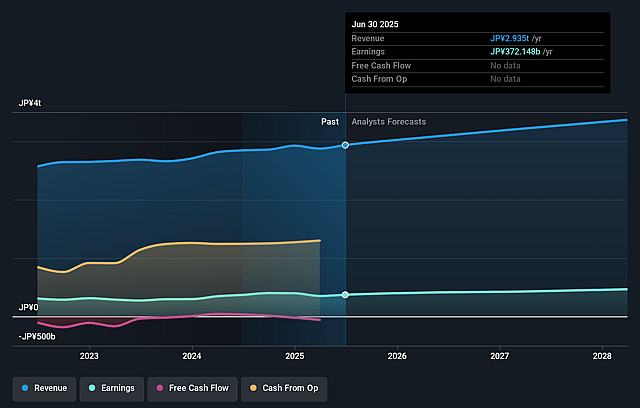
ORIX Future Earnings and Revenue Growth
Assumptions
How have these above catalysts been quantified?
- Analysts are assuming ORIX's revenue will grow by 4.9% annually over the next 3 years.
- Analysts assume that profit margins will increase from 13.4% today to 14.3% in 3 years time.
- Analysts expect earnings to reach ¥549.5 billion (and earnings per share of ¥540.02) by about August 2029, up from ¥447.2 billion today. However, there is a considerable amount of disagreement amongst the analysts with the most bullish expecting ¥615.2 billion in earnings, and the most bearish expecting ¥484.1 billion.
- In order for the above numbers to justify the price target of the analysts, the company would need to trade at a PE ratio of 14.3x on those 2029 earnings, down from 15.5x today. This future PE is about the same as the current PE for the US Diversified Financial industry at 14.3x.
- Analysts expect the number of shares outstanding to decline by 2.67% per year for the next 3 years.
- To value all of this in today's terms, we will use a discount rate of 5.01%, as per the Simply Wall St company report.
Risks
What could happen that would invalidate this narrative?- Heavy reliance on capital gains from asset sales (e.g., Greenko and Hotel Universal Port VITA) and valuation gains to achieve profit growth, rather than recurring operational improvements, raises the risk of lumpy and unsustainable earnings, potentially impacting net income and future EPS growth.
- Persistent macroeconomic uncertainty, particularly high interest rates in key markets like the U.S., is negatively impacting core businesses such as real estate lending and private equity, leading to recognized impairments, conservative asset reduction, and lower segment profitability-potentially reducing revenue and net margins.
- Exposure to legacy asset impairments-including goodwill and credit losses in the U.S. as well as unrealized losses in ORIX Life's bond portfolio-creates a risk of significant capital losses or reserve build-ups, which could depress reported earnings and shareholder equity.
- Management's admission that certain profit increases are driven by technical or one-off factors (e.g., early recognition of banking segment profits and capital gains in energy) suggests that base profit momentum may not be sustainable if market conditions worsen, potentially leading to disappointing results and lower ROE.
- The need to repeatedly review and potentially delay investment decisions, capital recycling schedules, and major acquisitions due to uncertain market conditions or tariff/geo-political impacts may limit ORIX's ability to deploy capital efficiently or achieve stable AUM growth, constraining long-term revenue and margin expansion.
Valuation
How have all the factors above been brought together to estimate a fair value?
- The analysts have a consensus price target of ¥6678.89 for ORIX based on their expectations of its future earnings growth, profit margins and other risk factors.
- However, there is a degree of disagreement amongst analysts, with the most bullish reporting a price target of ¥7500.0, and the most bearish reporting a price target of just ¥6100.0.
- In order for you to agree with the analysts, you'd need to believe that by 2029, revenues will be ¥3841.8 billion, earnings will come to ¥549.5 billion, and it would be trading on a PE ratio of 14.3x, assuming you use a discount rate of 5.0%.
- Given the current share price of ¥6328.0, the analyst price target of ¥6678.89 is 5.3% higher. The relatively low difference between the current share price and the analyst consensus price target indicates that they believe on average, the company is fairly priced.
- We always encourage you to reach your own conclusions though. So sense check these analyst numbers against your own assumptions and expectations based on your understanding of the business and what you believe is probable.
Have other thoughts on ORIX?
Create your own narrative on this stock, and estimate its Fair Value using our Valuator tool.
Create NarrativeHow well do narratives help inform your perspective?
Disclaimer
AnalystConsensusTarget is a tool utilizing a Large Language Model (LLM) that ingests data on consensus price targets, forecasted revenue and earnings figures, as well as the transcripts of earnings calls to produce qualitative analysis. The narratives produced by AnalystConsensusTarget are general in nature and are based solely on analyst data and publicly-available material published by the respective companies. These scenarios are not indicative of the company's future performance and are exploratory in nature. Simply Wall St has no position in the company(s) mentioned. Simply Wall St may provide the securities issuer or related entities with website advertising services for a fee, on an arm's length basis. These relationships have no impact on the way we conduct our business, the content we host, or how our content is served to users. The price targets and estimates used are consensus data, and do not constitute a recommendation to buy or sell any stock, and they do not take account of your objectives, or your financial situation. Note that AnalystConsensusTarget's analysis may not factor in the latest price-sensitive company announcements or qualitative material.


