

Last Update 30 Jul 26
Fair value Increased 47%JBHT: Freight Cycle Optimism Will Eventually Collide With Elevated Expectations
Analysts have lifted the fair value estimate for J.B. Hunt Transport Services from $150.00 to about $220.49, reflecting updated views on truckload pricing, intermodal volume momentum, cost efficiency, and the higher analyst price targets across the Street.
Analyst Commentary
Street research on J.B. Hunt Transport Services has turned more constructive on earnings power and intermodal growth, although not all specialists see the current share price as an easy entry point. Many recent reports highlight stronger than expected Q2 results, tighter truckload capacity, and improving intermodal volumes, while also flagging valuation and cycle risks that readers should weigh carefully.
Across the coverage universe, a wide range of updated price targets now spans roughly US$200 on the low end up to about US$370 on the high end. Outperform, Overweight, Buy, Positive, Hold, Neutral, Equal Weight, Market Perform, and Underweight ratings all appear in the mix. This spread signals that views on J.B. Hunt are far from uniform and that upside and downside scenarios are both on the table.
Supportive analysts cite truckload pricing momentum, intermodal margin strength, and cost efficiency as core pillars of their constructive stance on J.B. Hunt. Several firms reference better than expected Q2 earnings and revenue, stronger intermodal volumes, and structural cost actions as reasons to update models and raise longer term earnings assumptions. Some also point to what they see as a healthier freight backdrop into 2027, with tightening capacity and improving demand conditions that could support the company across intermodal, truckload, and dedicated offerings.
On the more balanced side, Neutral and Hold ratings often pair higher price targets with caution around the current stock valuation. These analysts recognize the recent operational momentum at J.B. Hunt but question how much of the freight cycle recovery and intermodal pricing potential may already be reflected in the share price. For readers, that split between ratings and targets is a cue to separate enthusiasm about the business from the price being paid for the stock.
While several large firms see room for continued earnings growth at J.B. Hunt, a few highlight the risk that expectations have moved up quickly. Some reports frame recent quarters as among the strongest in years and emphasize the importance of execution around pricing, volume growth, and cost controls if the company is to meet or exceed those expectations. Others call out the potential for freight markets and broader economic conditions to introduce volatility, even if their long term stance on the sector remains constructive.
JPMorgan and other bullish firms keep Overweight ratings and emphasize what they see as an improving truckload cycle and intermodal opportunity, supported by higher price targets such as US$280, US$309, US$313, US$335, and US$345 in recent notes. Goldman Sachs and other Neutral rated firms raise their targets as well, for example to US$239 and US$261, but stress that valuation already reflects a large portion of the intermodal and pricing story, which leads them to retain more cautious ratings despite solid recent performance.
Overall, the Street backdrop for J.B. Hunt is constructive but not unanimous. Readers looking at this stock may want to pay attention not just to headline target changes but also to the assumptions behind those targets, including freight cycle timing, intermodal share gains, pricing power, and the durability of recent margin trends.
Bearish Takeaways
- Bearish analysts highlight that valuation has already moved higher, and some argue that much of the anticipated freight market inflection and intermodal growth is reflected in the current share price, which limits perceived upside.
- Morgan Stanley downgraded J.B. Hunt to Underweight even while lifting its price target to US$200 from US$190, pointing to a freight cycle that it views as elevated and potentially prone to volatility, which could pressure returns if expectations reset.
- Several Hold and Neutral ratings, including from firms such as Goldman Sachs and Citi, pair higher price targets with caution that the stock valuation already discounts strong intermodal margins and pricing momentum, which raises the bar for future execution on earnings and growth.
- Some research characterizes the current setup as one where expectations for 2026 and 2027 are already robust, which creates downside risk if J.B. Hunt experiences slower load growth, softer pricing, or less favorable freight conditions than currently assumed in these models.
What’s in the News for J.B. Hunt Transport Services
- J.B. Hunt reported Q2 2026 revenue of US$3.50b, up 19% year over year, with diluted EPS of US$1.91, up 45%, and operating income of US$259.5 million, up 32%. The results beat Wall Street estimates and reflect broad based volume growth and cost efficiency gains. Source: Company Q2 2026 earnings coverage.
- The intermodal segment generated US$1.75b in Q2 2026 revenue, up 22% year over year, and set a quarterly volume record with more than 578,000 loads, up 10%. Intermodal operating income reached about US$150.9 million, up 58%, supported by rising fuel costs, tighter truckload capacity, and regulatory changes that increase broker liability. Source: Company Q2 2026 earnings coverage.
- J.B. Hunt removed over US$135 million in structural costs in Q2 2026, returned its brokerage segment to profitability for the first time in 14 quarters, repurchased about 392,000 shares for US$98 million, and reduced total debt to around US$1.15b. Source: Company Q2 2026 earnings coverage.
- Overroute publicly launched an AI powered freight execution platform that was co designed with J.B. Hunt and is now deployed across all of J.B. Hunt’s business units to support millions of loads. The platform focuses on automating load coordination, asset use, and customer communications. Source: Overroute and J.B. Hunt product launch reports.
- Cass Information Systems reported softer freight shipments in June but higher truckload rates year over year. J.B. Hunt also reported increased shipper interest in its intermodal and dedicated offerings following a Supreme Court ruling that widened broker liability exposure. Source: Cass freight and pricing report.
Valuation Changes for J.B. Hunt Transport Services
- The Fair Value Estimate has risen from $150.00 to about $220.49 per share, reflecting updated assumptions in the valuation model for J.B. Hunt.
- The Discount Rate has moved slightly higher from 8.09% to about 8.14%, which modestly increases the required return used in the analysis.
- The Revenue Growth assumption has risen from about 4.81% to roughly 5.61%, indicating a higher expected pace of future revenue expansion in the model.
- The Net Profit Margin assumption has edged up from about 6.52% to around 6.86%, implying a slightly stronger projected level of profitability for J.B. Hunt.
- The future P/E multiple has increased from about 17.20x to roughly 23.08x, which points to a higher valuation multiple being applied to projected earnings.
Catalysts
About J.B. Hunt Transport Services
J.B. Hunt Transport Services provides transportation and logistics services across Intermodal, Dedicated, Truckload, brokerage and Final Mile offerings in North America.
What are the underlying business or industry changes driving this perspective?
- Heavy investment in Intermodal capacity and technology has been made during a soft freight period. If highway to rail conversion progresses more slowly than management expects, the company could be left with underutilized assets that pressure revenue growth and limit earnings contribution from these projects.
- Management is targeting US$100 million of structural cost savings and highlighting AI, automation and process changes. If rising inflation in wages, benefits, equipment and insurance absorbs most of these gains, longer term net margin improvement may be far smaller than the current run rate suggests.
- Rail consolidation and changing Class 1 network structures could reduce J.B. Hunt’s bargaining power over time. If service patterns or access terms become less favorable, Intermodal pricing or volume mix could shift in ways that cap revenue growth and compress operating income.
- Dedicated and brokerage wins rely on customers consolidating freight with fewer, financially strong carriers. If shippers revert to more fragmented sourcing once capacity tightness or regulatory pressure eases, J.B. Hunt may face tougher pricing and mix, weighing on revenue per load and segment margins.
- Large buybacks and continued capital deployment into fleet, containers and technology are funded by current cash generation. If freight demand and rate conditions stay muted for longer than expected, returns on this capital could fall, limiting earnings growth and raising questions over the sustainability of current deployment levels.
Assumptions
How have these above catalysts been quantified?
- This narrative explores a more pessimistic perspective on J.B. Hunt Transport Services compared to the consensus, based on a Fair Value that aligns with the bearish cohort of analysts.
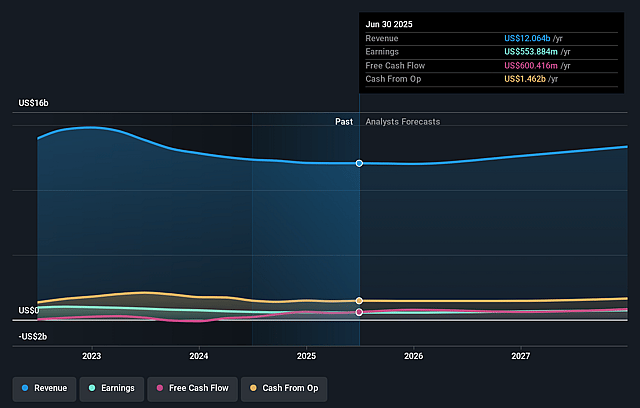
- The bearish analysts are assuming J.B. Hunt Transport Services's revenue will grow by 5.6% annually over the next 3 years.
- The bearish analysts assume that profit margins will increase from 5.3% today to 6.9% in 3 years time.
- The bearish analysts expect earnings to reach $1.0 billion (and earnings per share of $11.36) by about July 2029, up from $674.5 million today. However, there is some disagreement amongst the analysts with the more bullish ones expecting earnings as high as $1.3 billion.
- In order for the above numbers to justify the price target of the more bearish analyst cohort, the company would need to trade at a PE ratio of 23.3x on those 2029 earnings, down from 38.4x today. This future PE is lower than the current PE for the US Transportation industry at 37.3x.
- The bearish analysts expect the number of shares outstanding to decline by 2.98% per year for the next 3 years.
- To value all of this in today's terms, we will use a discount rate of 8.14%, as per the Simply Wall St company report.
Risks
What could happen that would invalidate this narrative?
- Management is heavily focused on operational excellence, with Intermodal and Highway services described as capturing additional volume and outperforming the market even while freight demand is soft. This focus could support steadier revenue and help protect earnings.
- The lowering cost to serve program has already removed more than US$20 million of structural costs in a single quarter toward a US$100 million target. Management links these efforts directly to better asset utilization and productivity, which could support higher net margins over time.
- The company reports that operating income improved 8% and diluted earnings per share improved 18% year over year on roughly flat revenue. This suggests that internal efficiency and cost controls are already having an effect on earnings despite muted demand.
- Customer feedback indicates shippers are consolidating freight with fewer, safe and financially solid carriers and are giving more business to providers like J.B. Hunt with strong service and diversified offerings. This trend could support long term volume, pricing power and revenue.
- Management highlights long term opportunities to convert highway shipments to Intermodal, growth in Eastern and Mexico related Intermodal volumes, and a healthy Dedicated sales pipeline with new truck deals and double digit margins. All of these factors could support revenue and earnings resilience over a multi year period.
Valuation
How have all the factors above been brought together to estimate a fair value?
- The assumed bearish price target for J.B. Hunt Transport Services is $220.49, which represents up to two standard deviations below the consensus price target of $305.45. This valuation is based on what can be assumed as the expectations of J.B. Hunt Transport Services's future earnings growth, profit margins and other risk factors from analysts on the more bearish end of the spectrum.
- However, there is a degree of disagreement amongst analysts, with the most bullish reporting a price target of $370.0, and the most bearish reporting a price target of just $182.0.
- In order for you to agree with the more bearish analyst cohort, you'd need to believe that by 2029, revenues will be $15.0 billion, earnings will come to $1.0 billion, and it would be trading on a PE ratio of 23.3x, assuming you use a discount rate of 8.1%.
- Given the current share price of $276.14, the analyst price target of $220.49 is 25.2% lower. Despite analysts expecting the underlying business to improve, they seem to believe the market's expectations are too high.
- We always encourage you to reach your own conclusions though. So sense check these analyst numbers against your own assumptions and expectations based on your understanding of the business and what you believe is probable.
Have other thoughts on J.B. Hunt Transport Services?
Create your own narrative on this stock, and estimate its Fair Value using our Valuator tool.
Create NarrativeHow well do narratives help inform your perspective?
Disclaimer
AnalystLowTarget is a tool utilizing a Large Language Model (LLM) that ingests data on consensus price targets, forecasted revenue and earnings figures, as well as the transcripts of earnings calls to produce qualitative analysis. The narratives produced by AnalystLowTarget are general in nature and are based solely on analyst data and publicly-available material published by the respective companies. These scenarios are not indicative of the company's future performance and are exploratory in nature. Simply Wall St has no position in the company(s) mentioned. Simply Wall St may provide the securities issuer or related entities with website advertising services for a fee, on an arm's length basis. These relationships have no impact on the way we conduct our business, the content we host, or how our content is served to users. The price targets and estimates used are consensus data, and do not constitute a recommendation to buy or sell any stock, and they do not take account of your objectives, or your financial situation. Note that AnalystLowTarget's analysis may not factor in the latest price-sensitive company announcements or qualitative material.


